

The Trust Builder
55. John D. Rockefeller

55. John D. Rockefeller (1839-1937)
The nineteenth century transformed the face of the nation. At its dawn, candlelight illuminated log homes, and horse and sail connected farms and small towns to a handful of distant cities. By its close, the United States had become an industrial dynamo built of steel, electrified, and powered first by coal and then by oil. This transformation did not happen by accident. It was built by men who mastered the new forces of industry, capital, and organization. Few did more to shape that new world than John D. Rockefeller. Born in 1839 in Richford, New York, into a country still powered by muscle and sail, Rockefeller lived long enough to see America become an industrial giant, lit by oil, moved by engines, and organized by corporations of staggering scale. His genius was organization. He saw chaos in the oil industry and made a system. He saw waste and made efficiency. He saw competition and consolidated it. In doing so, he became the richest man in modern history and one of the most controversial Americans who ever lived.
Rockefeller’s childhood was contradictory and did not obviously foretell his later career. His father, William Avery Rockefeller, was a charming wanderer, salesman, and occasional fraud who sold quack medicines and spent long stretches away from home. His mother, Eliza Davison Rockefeller, was pious, disciplined, and long-suffering. From her, Rockefeller learned thrift, self-control, religious devotion, and a strong work ethic. As a boy, he kept careful account books, recorded even the smallest transaction, and learned early how to save and invest. The habits that would later build an empire were already visible in miniature.
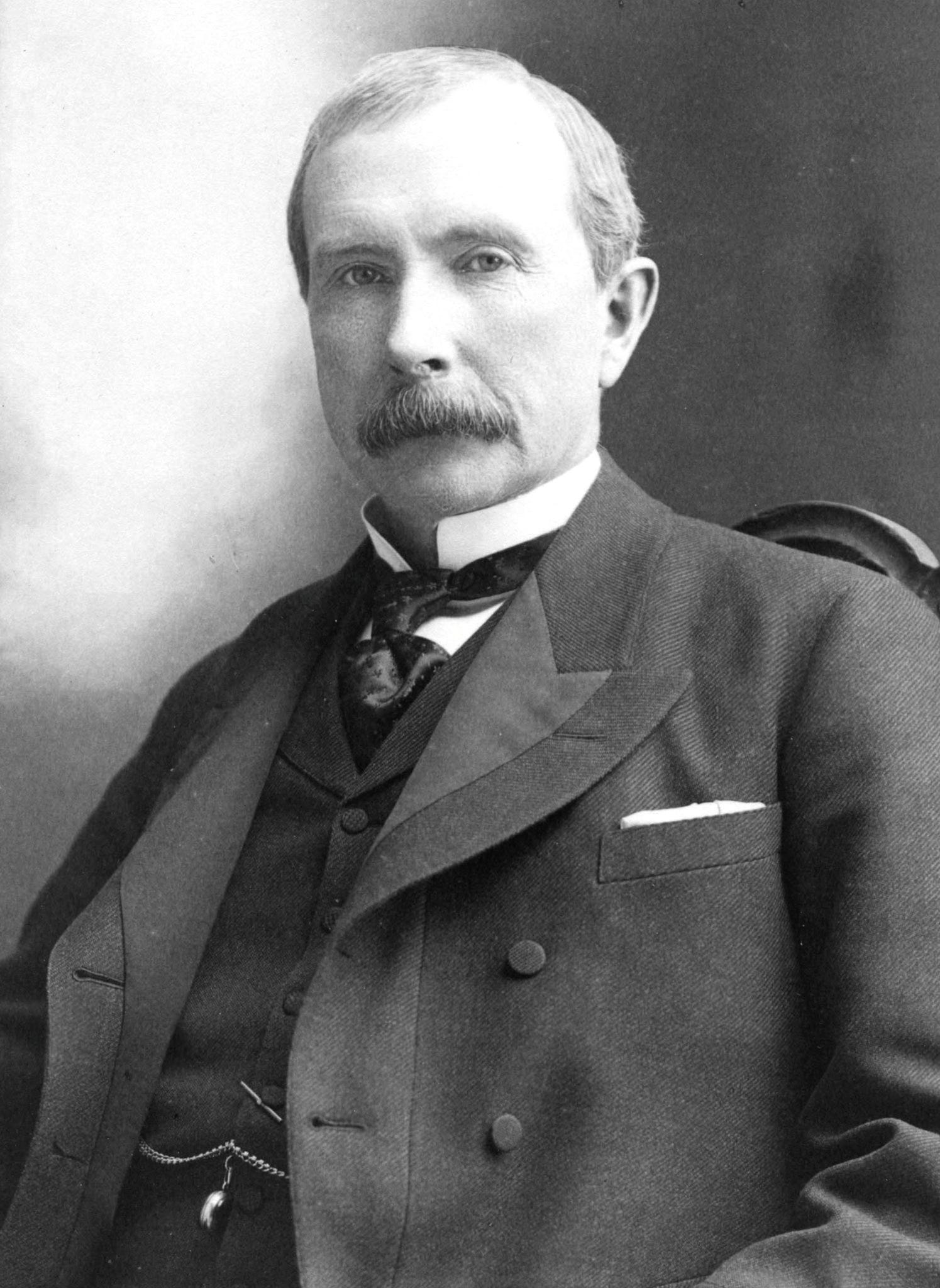
The family eventually moved to Cleveland, where Rockefeller entered business as a young man. He did not begin as a speculator or adventurer. He was a clerk, bookkeeper, and commission merchant. He was careful with figures, prudent with debt, and unusually savvy. In 1859, the same year Edwin Drake struck oil in Pennsylvania, Rockefeller and a partner opened a produce commission business. The oil industry soon attracted his attention. It was young, volatile, and disordered. Wells gushed and failed rapidly. Prices soared, then collapsed. Refineries appeared almost overnight and vanished nearly as quickly. Much of the industry was wasteful and dangerous, with roughly 40% of raw feedstocks going unused. Rockefeller saw opportunity in refining, transportation, and distribution.
In 1863, Rockefeller entered the refining business in Cleveland. He had found the field in which his talents mattered most. He studied every cost, every barrel, every shipment, and every byproduct. He pursued efficiency at every stage. Where others wasted gasoline, lubricants, paraffin, and residue, Rockefeller found uses for them. Where others paid standard freight rates, he negotiated discounts with railroads. Where others treated business as a gamble, he treated it as a discipline. His company grew because he managed it better than his rivals.
In 1870, Rockefeller and his associates formed the Standard Oil Company of Ohio. Its name was not accidental. Kerosene quality varied widely, and dangerous impurities could cause lamps to explode. Rockefeller wanted a dependable product sold under a dependable name. Standard Oil promised uniformity and reliability. But Rockefeller’s ambitions went far beyond quality control. He wanted order in an industry he believed was being ruined by reckless competition. His solution was consolidation.


That consolidation made him powerful and feared. Rockefeller bought out competitors, often offering them Standard Oil stock and positions within the larger organization. Some accepted willingly, recognizing that he could offer stability and profit. Others resisted and found themselves crushed by Standard Oil’s advantages in transportation, pricing, and supply. Rockefeller negotiated secret rebates with railroads, used his volume to obtain favorable rates, and sometimes received drawbacks on competitors’ shipments. To him, these were rational instruments of business. To his critics, they were the underhanded tactics of monopoly.
By the late 1870s, Standard Oil dominated American refining. In 1882, Rockefeller and his associates created the Standard Oil Trust, an arrangement that placed affiliated companies across the nation under centralized control. The trust became one of the defining institutions of the Gilded Age. It was efficient, profitable, and innovative. It also concentrated economic power on a scale that alarmed many Americans. The old Republic had feared kings and hereditary privilege. Now it faced a different question: what happens when private economic power becomes large enough to resemble sovereignty?
Rockefeller himself did not exactly look like a villain. He was quiet, religious, and personally austere. He attended church, taught Sunday school, gave liberally to Baptist causes, avoided lavish displays of wealth, and lived with remarkable personal discipline. He did not smoke or drink. He did not waste words. This made him both admirable and unnerving. He seemed like a man driven by principle, but the principle was conquest through efficiency.


Public opposition grew in the 1880s and 1890s. Journalists, reformers, farmers, small businessmen, and politicians increasingly saw Standard Oil as the emblem of corporate overreach. Ida Tarbell’s great exposé, published in the early twentieth century, did more than any other work to shape Rockefeller’s negative public image. Her criticism was personal, historical, and devastating. She portrayed Standard Oil as ruthless and Rockefeller as the architect of a vast system that bent markets to its will.
The legal reckoning came under the Sherman Antitrust Act. In 1911, the United States Supreme Court ordered Standard Oil broken apart into smaller competitors. By then, Rockefeller had largely withdrawn from day-to-day management, but the judgment marked a turning point in American law and economics. The Court concluded that Standard Oil had restrained trade and maintained monopoly power unlawfully. The breakup divided the empire into separate companies, including firms that would later become Exxon, Mobil, Chevron, and others. Ironically, the dissolution made Rockefeller even richer as the value of the successor companies rose.
Rockefeller’s later life was increasingly devoted to philanthropy. Here too, his instinct was organization. He did not merely give money away. He tried to professionalize charity, to make giving systematic and effective. He gave enormous sums to education, medicine, and scientific research. He helped found the University of Chicago, which became one of the great universities in the world. He supported Spelman College, named in honor of his wife’s family, and gave extensively to Black education when it was desperately needed. He created the Rockefeller Institute for Medical Research, later Rockefeller University, and the Rockefeller Foundation, which supported public health, medical science, education, and international humanitarian work.


This philanthropy was not window dressing. It changed the world. Rockefeller money helped advance medical research, fight hookworm in the American South, support public health campaigns abroad, and build permanent institutions. If his business career revealed the power of scale in industry, his philanthropy revealed its reforming promise.
But Rockefeller was not a villain redeemed by charity or a saint tainted by villainy. Both portraits are too simple. He was a great builder of the modern economy, and some of what he built was genuinely beneficial. Standard Oil lowered the price of kerosene by roughly 80%, improved quality, reduced waste, and brought light into millions of homes. Before Rockefeller, oil lighting was largely a luxury reserved for the rich. After him, it became broadly affordable. Standard Oil also helped make petroleum one of the central engines of modern life. Yet Rockefeller’s methods convinced many Americans that efficiency alone was not a sufficient civic virtue. Markets required rules, competition required protection, and private power required public limits.
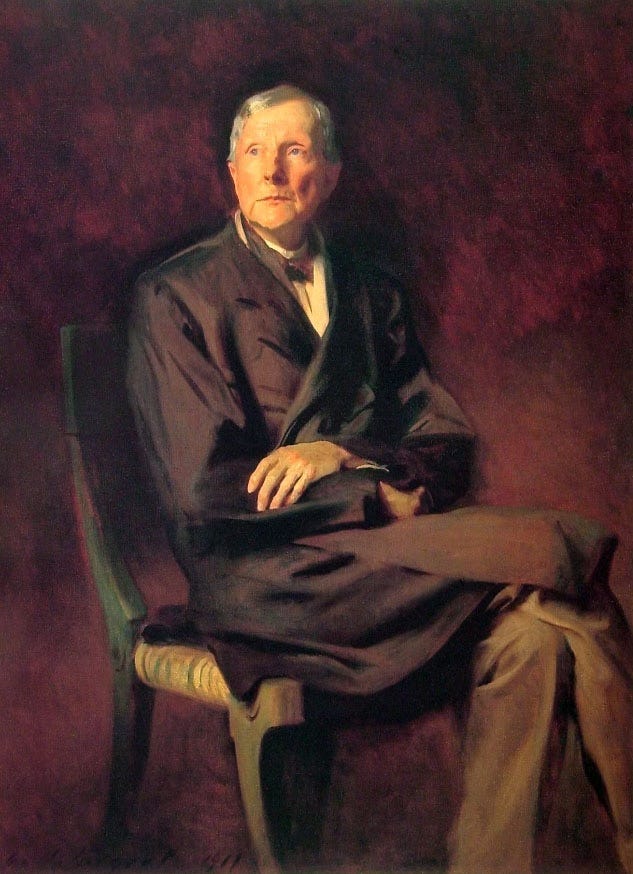
That is why Rockefeller belongs near the center of the American story. He unleashed the immense creative and transformative force of capitalism, but also its tendency to overrun older boundaries. He proved what discipline, thrift, intelligence, and organization could accomplish. He also showed why a free people would not allow even brilliant men to govern whole sectors of national life. The Republic needed men like Rockefeller to build, but it also needed law to restrain them. Rockefeller helped illuminate the world while casting a long shadow over it. He was more than merely a rich man.
with gratitude, and love—