

The Right Stuff
65. John Glenn

64. John Glenn (1921-2016)
Some men seem almost fashioned for the moment history demands. Such was John Glenn. After Sputnik, America found itself badly behind in the Space Race. The Soviets had launched the first satellite, sent the first man into space, and then placed the first man into orbit. To answer, the United States needed a new kind of hero: an astronaut. In 1959, no one fully knew what that required beyond courage, discipline, and what Tom Wolfe later called “the right stuff.” John Glenn had that in abundance. He was a decorated Marine aviator, a skilled test pilot, and a man of unusual calm under pressure. More than that, he inspired confidence. When the moment came for an American to orbit the Earth, the nation trusted John Glenn to make the journey.
John Herschel Glenn Jr. was born in 1921 in Cambridge, Ohio, and grew up in the small town of New Concord. His father operated a plumbing business, and his mother was a teacher. He grew up in a modest household in a small town. Glenn later spoke often of the stability of that upbringing, particularly of the strong sense of obligation it instilled within him. Aviation captured his imagination from an early age, and he spent hours building model airplanes. After high school, Glenn attended Muskingum College, where he studied engineering and joined the Civilian Pilot Training Program.
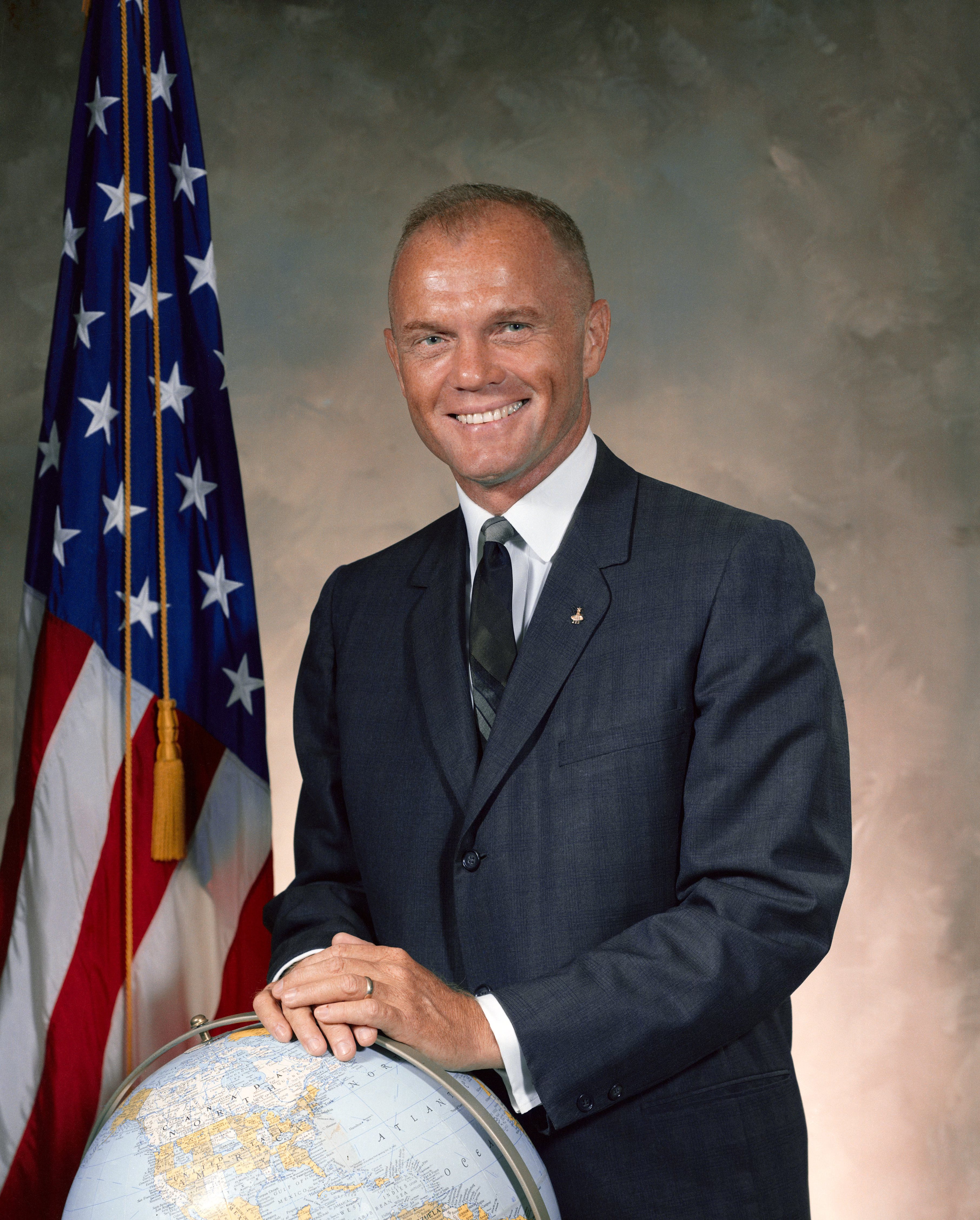
After the attack on Pearl Harbor and America’s entry into the Second World War, Glenn left college and entered military service. He joined the United States Marine Corps and trained as a combat pilot. He flew combat missions in the Pacific theater, first in the Marshall Islands and later supporting operations in the final stages of the war. Glenn earned a reputation for extraordinary technical skill and composure. He was methodical, serious, and intensely prepared.
After the war, Glenn remained in the Marine Corps. This decision would shape everything that followed. During the Korean War, he again flew combat missions, first with Marine squadrons and later on exchange duty with the Air Force, where he flew the F-86 Sabre in jet combat. He completed nearly ninety missions in Korea and earned several decorations for valor and distinguished flying. His war years established him not merely as a distinguished military pilot, but as one of the country’s elite aviators.
The Cold War military increasingly valued test pilots, men who could push aircraft to their limits and survive the experience. Technology was advancing rapidly, particularly jet propulsion and avionics. Test pilots had to adapt to entirely new paradigms of aviation. Glenn entered that world and gained national attention in 1957 when he completed the first supersonic transcontinental flight across the United States, flying from Los Angeles to New York in just over three hours. The feat was practical and symbolic. America was entering the Jet Age. But the Cold War was also an age of intercontinental ballistic missiles, nuclear weapons, and intense competition for technological supremacy.
Then came Sputnik.


When the Soviet Union launched the first artificial satellite in 1957, the shock to the American public was immense. It was not just a scientific achievement by a rival power. It was a strategic humiliation. Space had become the newest theater of competition, and the United States suddenly fell far behind. In response, the federal government accelerated its efforts and created the National Aeronautics and Space Administration. From the military’s best test pilots, seven men were selected for Project Mercury, America’s first human spaceflight program. John Glenn was one of the original Mercury Seven, America’s first astronauts.
The astronauts became national celebrities overnight. They were presented as the ideal American type: disciplined, family-oriented, brave, and technically gifted. Glenn fit the image perfectly. He and his wife Annie, whom he had known since childhood, projected modesty, steadiness, and decency. Yet the work was immensely dangerous. Early American rockets were unreliable and often exploded upon launch. Human spaceflight was still an experiment with mortal stakes, and engineers and astronauts alike acknowledged that they did not know all the risks before them.


In 1961, the Soviet Union struck another blow when Yuri Gagarin became the first human in space. America answered only weeks later when Alan Shepard completed a suborbital flight, but the symbolic race remained unsettled. The greater milestone was orbital flight. Whoever mastered that first would claim a profound psychological victory.
On February 20, 1962, John Glenn climbed into Friendship 7 atop an Atlas rocket at Cape Canaveral. His mission was to become the first American to orbit the Earth. The launch carried enormous national significance. President Kennedy was watching, as was the world.
The flight was not smooth. Glenn completed three orbits, but a warning light suggested that the spacecraft’s heat shield might be loose. If true, reentry could be fatal. Mission control made the decision to keep the retrorocket package attached in hopes it would help secure the shield. Glenn, aware of the risk, remained calm and followed procedures. Friendship 7 reentered safely and splashed down in the Atlantic.
The mission transformed him instantly into one of the most famous men in America. There were ticker-tape parades in New York and celebrations across the country. Although the space race was not won, Glenn had restored confidence. America could do this. The nation could compete with the Soviet Union not only in arms, but in human daring and scientific achievement.
NASA did not return Glenn to space immediately. After his flight, Glenn’s public importance had become too great, and there was concern about risking a national hero. Glenn himself was frustrated by this caution. He wanted to fly again. Instead, after leaving NASA and the Marine Corps, he turned toward public service.


His first attempt at politics came in 1964, when he sought a Senate seat from Ohio, but an injury and party complications ended that effort. Instead, he bided his time by going into business. He eventually succeeded in 1974, winning election to the United States Senate as a Democrat from Ohio. He would serve there for twenty-four years.
As a senator, Glenn carried on his previous reputation. He eschewed rhetorical partisanship, and his style remained what it had always been: serious, prepared, and institutional. He worked extensively on military affairs, nuclear nonproliferation, science policy, and government oversight. He was particularly interested in reducing the threat of nuclear weapons and strengthening arms control during the late Cold War. He also pursued investigations into government waste and administrative reform. His Senate career lacked the drama of orbital flight, but it reflected the same habits of discipline and duty.
He sought the presidency briefly in 1984, but the campaign never gained real momentum. Americans admired him, but recognized that although he had the “right stuff” to be an astronaut, the presidency required different skills. He returned to the Senate and continued the quieter work of legislation.
But Glenn had one more act of physical daring. In 1998, at the age of seventy-seven, he returned to space aboard the Space Shuttle Discovery. The flight was partly framed as scientific research into aging and the effects of spaceflight on the human body, but it was also unmistakably symbolic. The young Marine pilot who had orbited the Earth at the dawn of the Space Age was now returning as an elder statesman of that age. It was a moment of national nostalgia and a celebration of the successful Space Race, but also of continuity. Few lives so clearly linked the heroic age of early space exploration to the modern era.
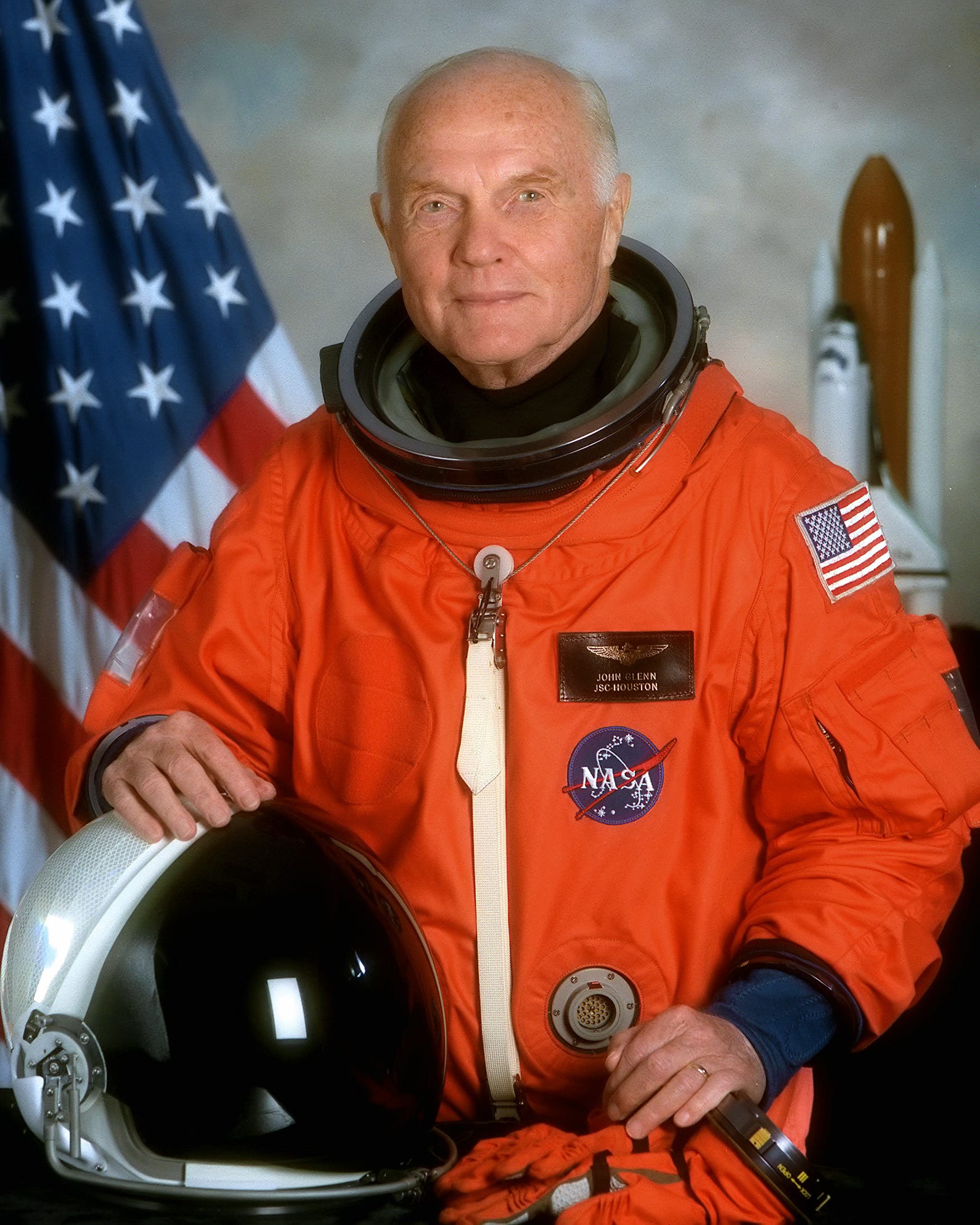
John Glenn retired from the Senate the following year. He remained active in education and public life, particularly through work at Ohio State University on public service and policy studies. He died in 2016 at the age of ninety-five.
John Glenn’s legacy is unusually pristine by modern standards. There were a few minor political controversies, as there always are in long public careers, but Glenn was never primarily remembered for scandal, ambition, or ideological combat. He was remembered for competence and trustworthiness. In our loud age, that is a noble legacy.
In his youth, John Glenn represented a distinctly mid-century American ideal. He was patriotic without being performative, ambitious without vanity, and technologically modern without cynicism. He belonged to a generation that believed public service was honorable and expected. He fought in two wars, helped carry the Republic into space, and spent decades in the patient labor of republican government.
Some astronauts were braver. Many senators were more powerful. Few were more widely trusted. As Glenn orbited the Earth, and long after he returned, his life of service proved that Americans could confidently and calmly go into the unknown.
with gratitude, and love—