

The First Lady
38. Eleanor Roosevelt

38. Eleanor Roosevelt (1884-1962)
America has been blessed with many influential and remarkable First Ladies, but only one became a stateswoman in her own right. Many occupied the role with grace, intelligence, and political usefulness. Eleanor Roosevelt redefined it. She did not merely host dinners, champion charitable causes, or extend her husband’s political career. She became one of the most visible, consequential, and morally serious public figures of the twentieth century. In an age of depression, war, dictatorship, and social upheaval, Eleanor Roosevelt became a public conscience for American liberalism and, eventually, for human rights more broadly.
Anna Eleanor Roosevelt was born in New York City in 1884 into privilege, but not security. She was a Roosevelt by blood, a niece of Theodore Roosevelt, but her childhood was lonely rather than glamorous. Her father, Elliott Roosevelt, was charming but haunted by alcoholism. Eleanor adored him. Her mother, Anna Hall Roosevelt, was socially prominent but emotionally cold, and reportedly calling Eleanor “granny” because of her serious expression and awkward appearance. Her mother died when Eleanor was eight; her father died when she was ten. By adolescence, she was effectively orphaned.
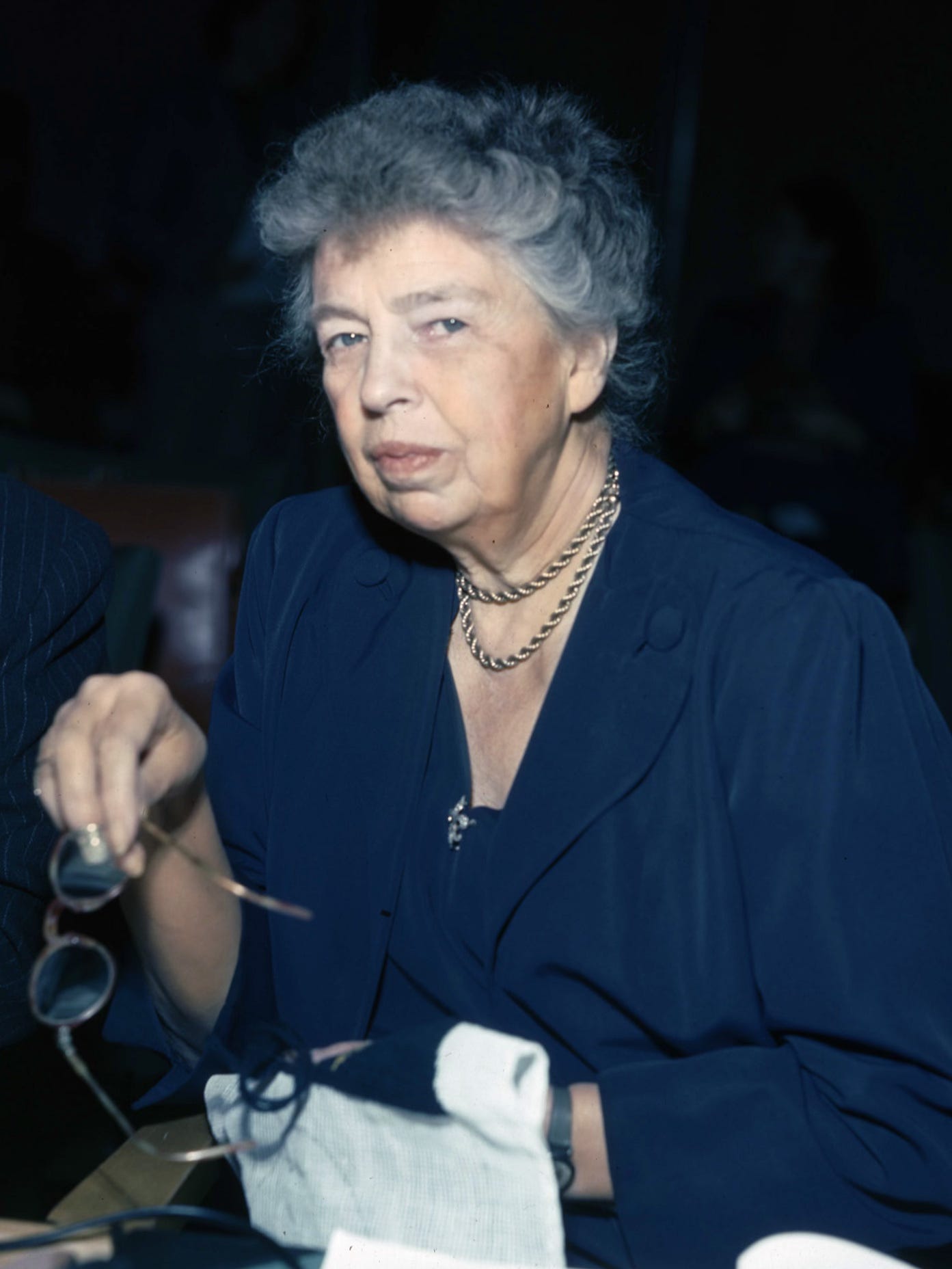
That early loneliness formed in her both a painful insecurity and a deep empathy for others’ suffering. She was not a naturally charismatic figure. She was tall and awkward, earnest and shy. But education changed her. Her years at Allenswood Academy in England under the headmistress Marie Souvestre transformed her. Souvestre was demanding, cosmopolitan, skeptical, and fiercely independent. Eleanor flourished there, gained confidence, and developed a broader understanding of the world.
In 1905, she married her distant cousin Franklin Delano Roosevelt. Theodore Roosevelt, then president, gave her away at the wedding, fitting symbolism for a union already wrapped in public significance. Eleanor soon entered the demanding world of elite politics and high domestic expectation. She bore Franklin six children, five of whom survived infancy. The marriage, however, was deeply complicated. Franklin was ambitious, charming, and politically gifted, but also emotionally elusive and serially unfaithful. Eleanor discovered his affair with Lucy Mercer, their social secretary, in 1918, a devastating moment that permanently altered the marriage. Though they remained partners, the relationship became more political and functional than romantic. That rupture may well have accelerated Eleanor’s independence.


Franklin’s struggle with polio in the 1920s changed the dynamic further. As his physical world narrowed, Eleanor’s public role expanded. Though naturally aligned with Franklin’s political interests, she became politically active in her own right, working with reform organizations, labor advocates, women’s groups, and Democratic Party activists. She taught at the Todhunter School, supported the Women’s Trade Union League, and built relationships with progressive reformers. By the time Franklin became governor of New York, Eleanor was already far more than a conventional political spouse. She was no mere hostess.
When Franklin became president in 1933, America was in catastrophe. Banks were failing, unemployment was staggering, and public confidence had collapsed. The First Lady had traditionally occupied a ceremonial and social role. Eleanor ignored that history. She held women-only press conferences, forcing newspapers to hire female reporters if they wanted access. She traveled constantly, often to places Franklin could not easily go. She visited mining towns, labor camps, schools, military bases, and impoverished communities. She became the president’s eyes and ears in a practical sense, but she was more than that. She was an independent political actor, publicly advocating positions that sometimes exceeded Franklin’s comfort and political instincts.
She also took up her pen. Her newspaper column, My Day, became an institution. Day after day, year after year, Americans encountered a First Lady speaking directly and constantly to the public. The scale of her communication was unprecedented.
Her politics were progressive, even stridently so for the time. She advocated labor protections, expanded opportunities for women, youth employment, civil rights, and relief for the poor. She developed particularly important relationships with African American leaders, including Walter White of the NAACP and Mary McLeod Bethune. Her resignation from the Daughters of the American Revolution after it refused to allow Marian Anderson to perform at Constitution Hall became one of the great symbolic civil rights moments of the era. The subsequent Lincoln Memorial concert was a dignified and powerful rebuke to segregation.
Still, her record was not spotless. She pushed Franklin on civil rights, but the administration remained constrained by Southern Democrats who formed a critical part of the New Deal coalition. Anti-lynching legislation failed. Segregation endured. Japanese internment during World War II remains a grave stain on the administration, though Eleanor’s own position was often more humane than those around her.
World War II elevated her role even further. She traveled to troops overseas, visited the vast Pacific theater, inspected hospitals, and became an extraordinary morale figure. She had enormous stamina. Her schedule would have exhausted younger people. She wrote, traveled, spoke, met, advocated, and worked constantly. When Franklin died in April 1945, many assumed her public life would end.


Instead, it entered its most globally consequential phase. President Truman appointed her to the United Nations General Assembly. It proved an inspired choice. Skeptics who regarded her as merely a famous widow badly underestimated her. She possessed unusual political discipline, courage, diplomatic tact, and relentless work ethic. She became chair of the committee that drafted the Universal Declaration of Human Rights. That achievement alone would justify her place in any American ranking.
The twentieth century had witnessed industrialized slaughter, genocide, total war, ideological barbarism, and the demonstrated capacity of modern states to destroy human dignity on a staggering scale. The Universal Declaration was not a treaty and lacked direct enforcement power, but that misses the point. It articulated a shared language of human dignity after civilization had shown what its collapse could look like.
Its language now feels familiar precisely because it succeeded. Human dignity, freedom of conscience, equality before the law, freedom from arbitrary detention, and rights to participation and security have become foundational concepts, though history suggests their fragility.
She remained politically active for the rest of her life, supporting Democratic candidates, writing prolifically, speaking constantly, and continuing public advocacy. Even when critics found her naïve or overly liberal, few doubted her sincerity. She died in 1962.
Her significance is difficult to overstate. She redefined the First Ladyship from ceremonial domesticity into public leadership. She became one of the most important female political figures in American history without ever holding elected office. She helped center civil rights and social reform around the dignity and welfare of the individual. Eleanor Roosevelt was a democratic moral force. Few Americans have done more to expand the meaning of public service.
with gratitude, and love—