

Springtide
87. Rachel Carson

87. Rachel Carson (1907-1964)
By the middle of the twentieth century, scientific advances had transformed American society. These changes were visible everywhere, in media, transportation, industry, and increasingly in agriculture. Crop yields rose through chemical innovation. Fertilizers became more efficient, and pesticides promised to eliminate the insects that had long consumed a portion of every harvest. What earlier generations had accepted as an unavoidable loss now seemed solvable. Modern chemistry promised mastery over nature.
Yet that mastery carried consequences not immediately seen. The same chemicals designed with precision to kill insects did not remain confined to their targets. They moved through soil, water, and air, producing effects that were poorly understood and largely unexamined. Pesticides were only one expression of a broader pattern. The scientific triumphs of modern America were improving daily life, but they were also imposing costs on the natural world that remained hidden from public view. It would fall to a careful observer, grounded in both science and language, to bring those costs into focus. That observer was Rachel Carson.
Rachel Carson was born on May 27, 1907, in Springdale, Pennsylvania, a small river town. The Allegheny River moved steadily past her childhood home, and beyond it lay hills, fields, and woods that formed the earliest contours of her imagination. Carson’s first ambition was literary. As a child she wrote stories and saw herself as a writer long before she imagined a life in science. That instinct never left her. It would become the instrument through which she translated science into something intelligible and enduring. But at the Pennsylvania College for Women, where she enrolled in 1925, her path shifted. She entered as an English major and left as a biologist.
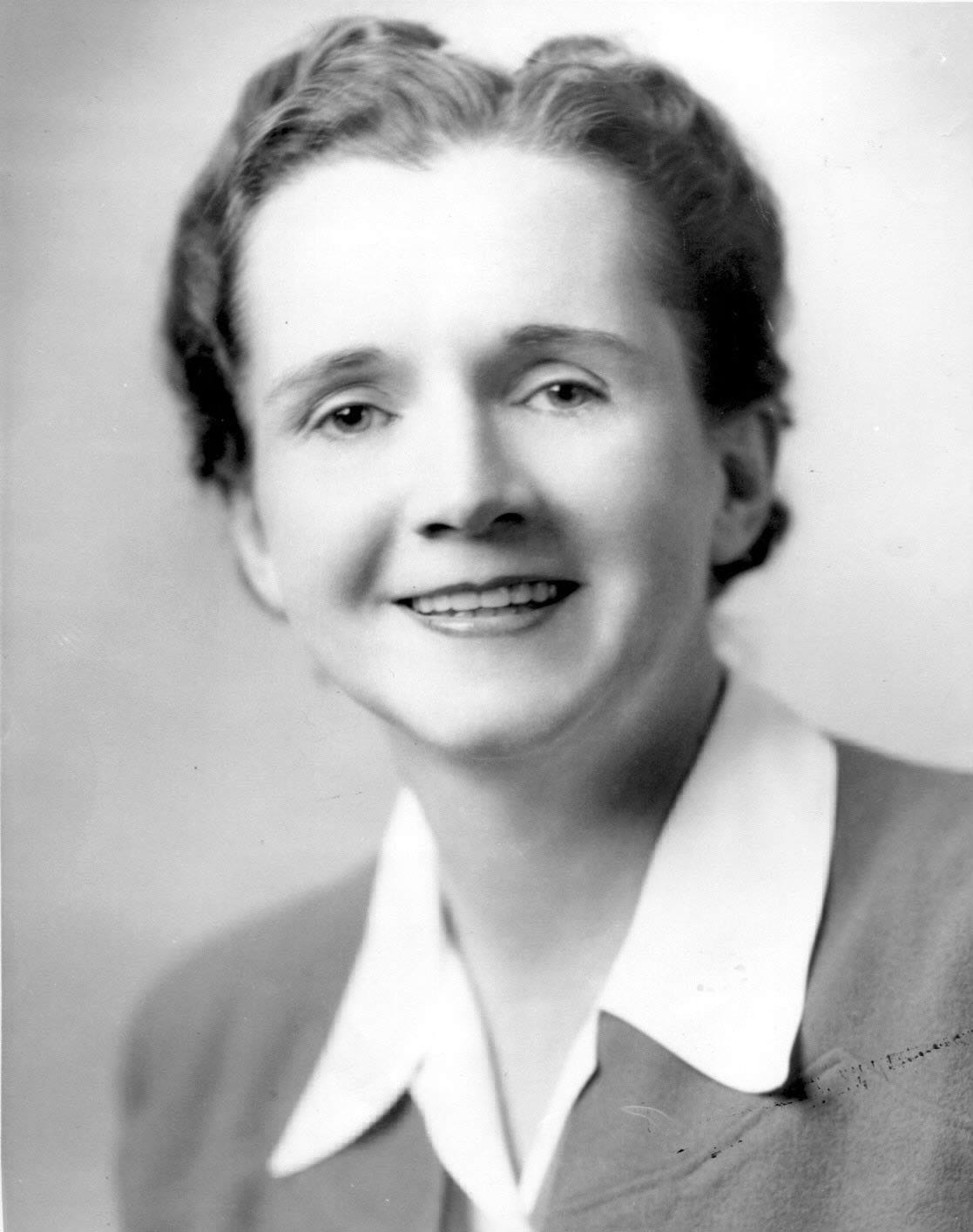
She continued to graduate work at Johns Hopkins University, one of the few institutions at the time that offered women a path into advanced scientific study. There she focused on marine biology, drawn by the complexity and mystery of the sea. Her academic career unfolded under strain. The Great Depression narrowed opportunities, and Carson bore increasing financial responsibility for her family after her father’s death. She moved between fellowships, teaching assignments, and part-time work, balancing intellectual ambition with necessity.
In 1936, Carson secured a position with the U.S. Bureau of Fisheries, later incorporated into the Fish and Wildlife Service. It was not, at first, a glamorous post. She was hired to write radio scripts for a series called Romance Under the Waters, designed to educate the public about marine life. Yet this work proved foundational. Carson learned to communicate complex scientific ideas in clear, approachable language without diluting the science. She began to shape a voice that would later command national attention.
Her first book, Under the Sea-Wind, appeared in 1941. It was a modest debut, published just as the United States entered World War II, and it received little immediate recognition. But it established the pattern of her work. Carson wrote from within the perspective of the natural world, tracing the lives of fish and birds with a precision grounded in science and a style that carried a quiet, steady rhythm.
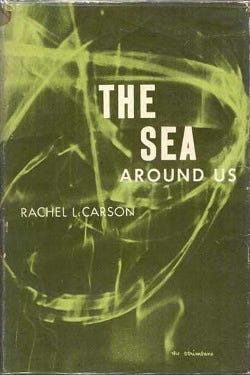
A decade later, she achieved a very different reception. The Sea Around Us, published in 1951, became a national bestseller and won the National Book Award. The book offered a sweeping account of the oceans, from their geological origins to their living systems. It depicted the sea as a dynamic, interconnected whole, governed by forces that extended across time and space. Carson’s success allowed her to leave government service and devote herself entirely to writing. It also placed her in a position of unusual influence. She had earned the confidence of a broad readership.
Her next work, The Edge of the Sea (1955), continued this exploration, focusing on coastal environments. These books were not controversial. They invited readers to see the natural world more clearly and to recognize patterns that had always been present but rarely articulated. Carson’s reputation, at this stage, was that of a gifted interpreter of nature rather than a critic of modern society. That changed in the late 1950s.
Carson’s attention turned, gradually and then fully, to the increasing use of synthetic pesticides in American agriculture. Chemicals such as DDT had been widely deployed during and after World War II, praised for their effectiveness in controlling insects. Their use expanded rapidly, often with little thought to long-term effects. Reports began to reach Carson of declining bird populations and unexplained ecological disturbances. She began investigating.
The work was demanding. Carson reviewed scientific studies, corresponded with researchers, and compiled case histories. She was not a trained chemist and relied on the expertise of others, but she sought patterns, connections, and consistency in the data. What emerged was a systemic problem. Chemicals were entering ecosystems, accumulating in soil and water, and moving through food chains in ways that magnified their effects.
Carson did all this while battling breast cancer, at a time when the disease was still often a death sentence.
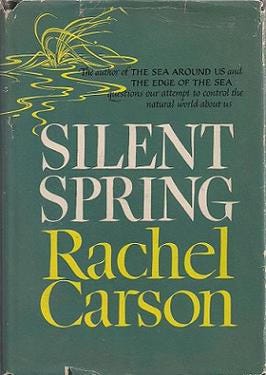
In 1962, she published Silent Spring. The book opened with a brief, imagined portrait of a town where birds no longer sang, where the familiar sounds of spring had fallen silent. Carson then presented her evidence in measured, deliberate prose. She did not claim that all pesticides were inherently harmful or that they should be entirely abandoned. She argued that their indiscriminate use, without adequate understanding of ecological consequences, posed a serious risk.
The reaction was immediate and intense. Chemical companies mounted public campaigns to discredit her work. Industry representatives questioned her scientific competence and suggested that her conclusions were exaggerated. Some critics framed her arguments as a threat to agricultural productivity and public health. Carson responded with the evidence she had assembled. She appeared before Congress, testified to her findings, and reiterated the central point of her work: human intervention in complex natural systems requires caution and humility.
President John F. Kennedy directed his Science Advisory Committee to investigate the issues raised in Silent Spring. The committee’s report, issued in 1963, supported many of Carson’s conclusions and called for a reassessment of pesticide policies. Public awareness grew, and the question of environmental responsibility entered the national conversation in a sustained way.
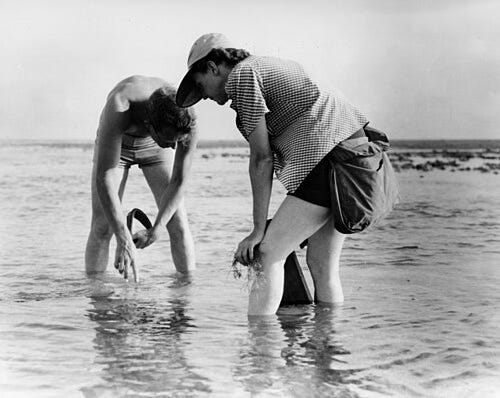
Carson’s work helped to catalyze a broader environmental movement that would lead, in the years after her death, to significant institutional changes, including the passage of legislation and the creation of the Environmental Protection Agency in 1970 and the eventual restriction of DDT use in the United States.
She did not live to see those developments. Rachel Carson died from complications of breast cancer on April 14, 1964, at the age of fifty-six. By that time, her influence was already evident. She had altered the terms of a national debate and introduced a framework for thinking about the relationship between human activity and the natural world that would persist beyond her lifetime.
Rachel Carson’s place in American life rests not only on the policy changes that followed her work, but on the example she set. She demonstrated that a well-stated argument, grounded in evidence and expressed with clarity, can shape public understanding on matters of consequence. Her authority derived from the alignment of evidence and expression.
Her life also shows how public opinion and representative government can work together. Guided by scientific evidence, she brought forward issues of public importance that moved opinion and prompted debate. Elected officials considered those questions and responded with policy that, in time, gained broad acceptance. Few today call for the return of DDT. Agriculture endures. And in the spring, the birds still sing.
with gratitude, and love—