

Scientific Manager
54. Frederick Winslow Taylor

54. Frederick Winslow Taylor (1856-1915)
America has always been vast, but it has not always been a land of abundance. Before the Industrial Revolution, the American economy rested largely on handcraft and muscle power, whether human or animal. Farmers toiled in the fields, planting by season and weather, while smiths and carpenters hammered and sawed with their own hands. Production depended heavily on individual judgment, inherited habits, and local custom. It was often more a matter of art than method. Skilled craftsmen were called artisans for a reason. Even after the introduction of machines, production remained haphazard and uneven. But by the late nineteenth century, the nation was changing. Railroads spanned the continent. Steel mills ran day and night. Factories employed thousands. Production was no longer primarily a matter of individual craftsmanship. It became a system requiring coordination, discipline, and scale. As industrial output expanded, the central question became how to organize human labor itself. Few men did more to answer that question than Frederick Winslow Taylor.
Taylor was born in 1856 in Germantown, Pennsylvania, into a wealthy Quaker family. His father, Franklin Taylor, though heir to considerable wealth, also trained and worked as a lawyer, while his mother, Emily Annette Taylor, was known for her intelligence and political activism. Taylor received an elite education, including time at Phillips Exeter Academy. He seemed destined for Harvard and the law. But poor eyesight intervened, forcing him to abandon that plan. The setback changed the course of his life. Rather than entering the professions, he entered industry.
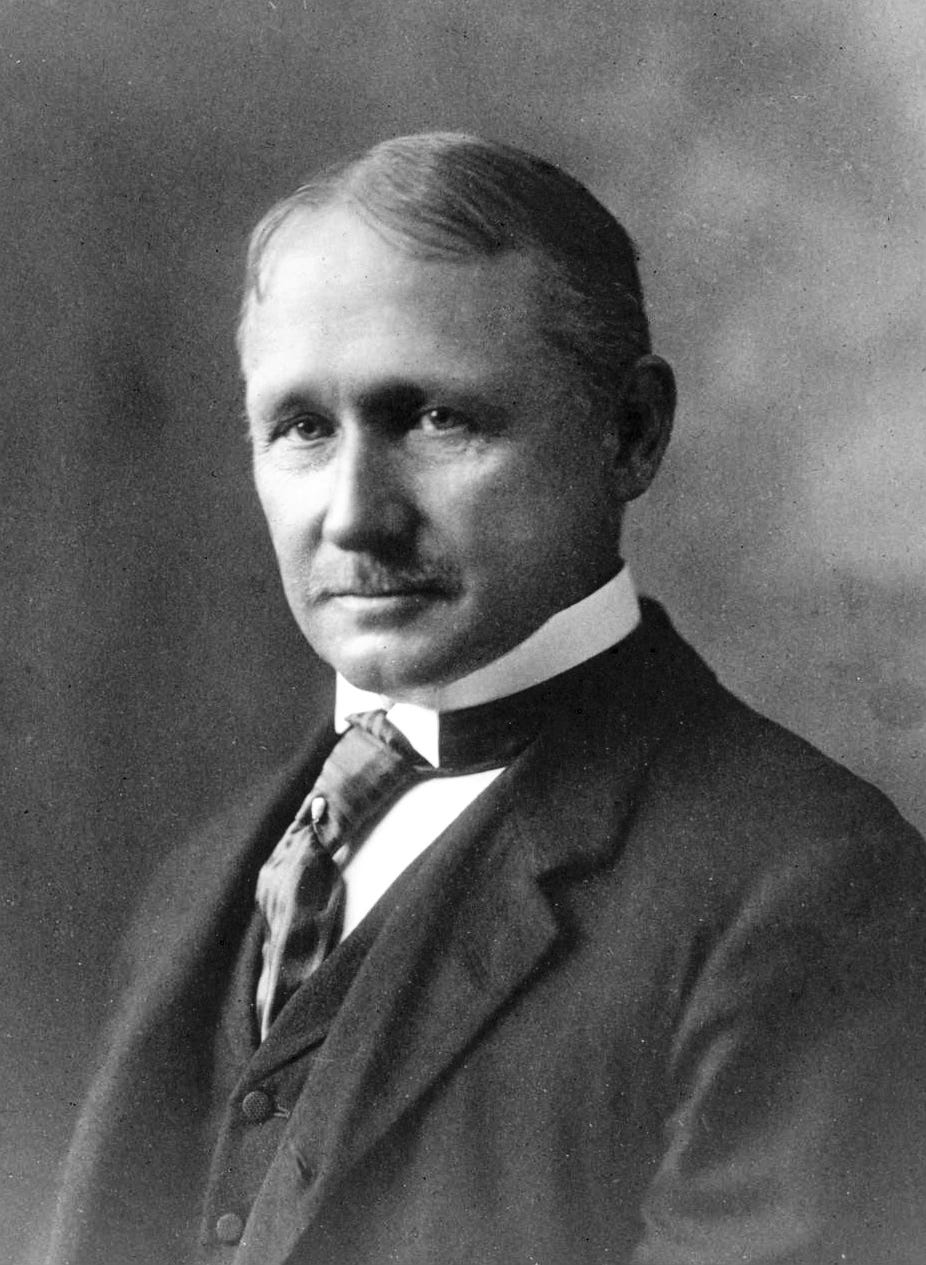
This personal turn in fortune was remarkable. Taylor did not enter manufacturing as an executive or clerk. Despite his education, family wealth, and connections, he began on the shop floor. In 1874, he apprenticed as a patternmaker and machinist in Philadelphia. There he encountered the realities of industrial labor firsthand. He experienced the rhythms of the workshop, learned the informal rules among workers, and witnessed the practical improvisations of the shop floor. These were formative experiences, and although Taylor came to sympathize with workers to some degree, he did not conclude that laborers required liberation from managers. He concluded that they required better management.
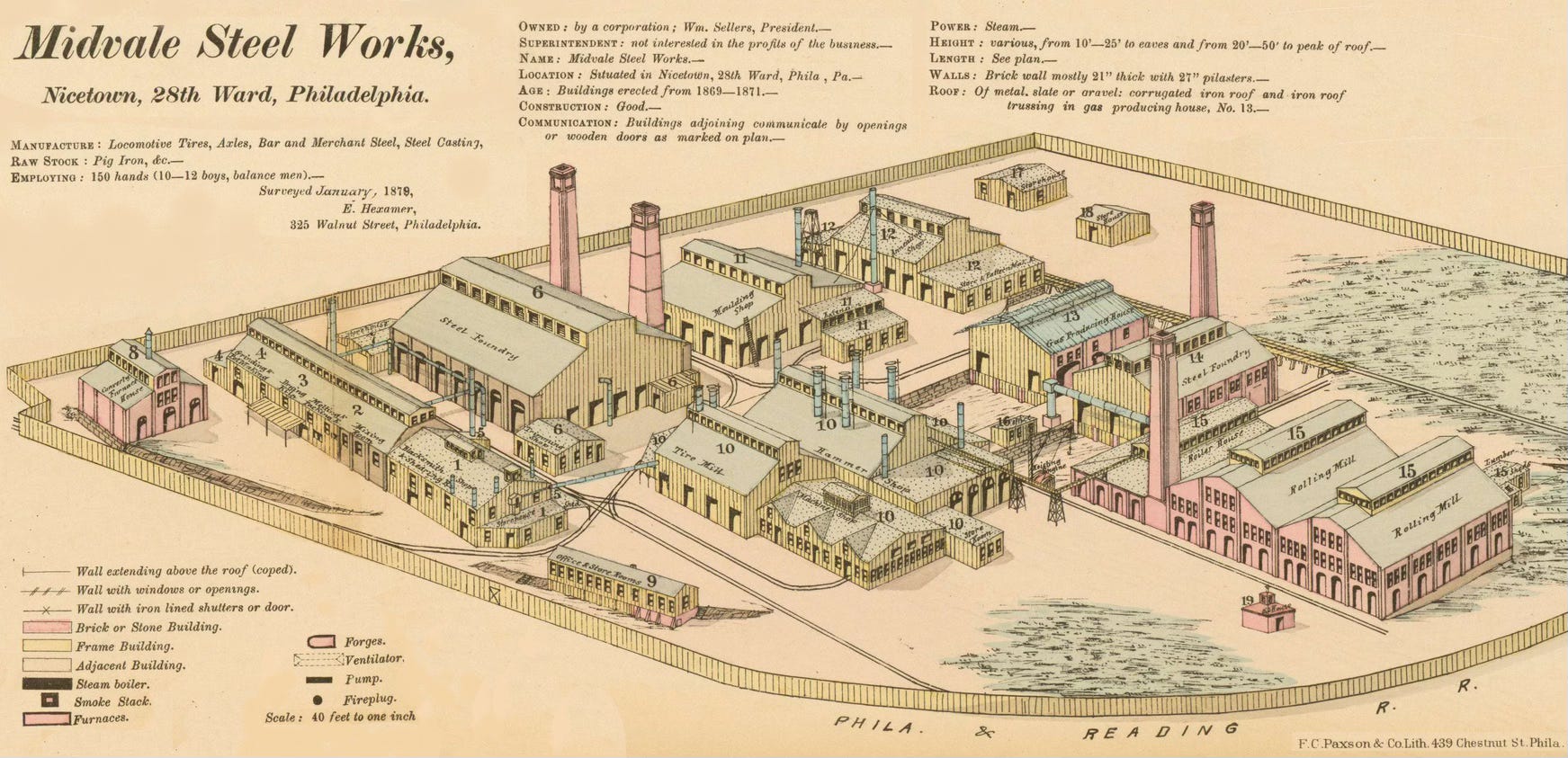
In 1878, Taylor joined Midvale Steel Works in Philadelphia as a common laborer, but his rise was rapid. He worked as a machine hand, then gang boss, then foreman, then chief engineer. Along the way, he studied engineering at night through the Stevens Institute of Technology, earning a degree while continuing full-time work. Midvale became his laboratory.
Taylor’s initial experience at Midvale was deeply frustrating to him. Workers routinely engaged in what he called “soldiering,” the deliberate restriction of output. Some did so out of poor production habits. Others feared efficient work would lead to layoffs or higher expectations without better pay. An informal shop culture had developed that encouraged moderate rather than maximum output. Although the workers collectively knew how to maximize production, this knowledge was dispersed and often concealed rather than systematically implemented by managers. Taylor saw this as irrationally wasteful. And to a Quaker, waste was nigh unto sin.
His response was rigorous and intensely managerial, a term that would forever be associated with him. Taylor began timing tasks with a stopwatch, breaking jobs into component motions, measuring output, and searching for what he believed was the single most efficient method for each component activity. The premise was simple. If one could discover the optimal method for a task, train workers to perform it consistently, and align compensation with productivity, output would increase dramatically. This approach became the foundation of what Taylor called “scientific management.”
But Taylor was not merely interested in exhorting or harassing workers. He believed management itself had failed by relying on old rules of thumb, imprecise guesswork, and outdated tradition. Industry was new and powerful, so industrial administration should become a science grounded in observation, measurement, standardization, and experiment. Management should determine the best method while workers should execute it.
The most famous illustration came during Taylor’s time at Bethlehem Steel in the 1890s. There, he conducted studies on tasks such as shoveling materials and moving pig iron. In one now-famous and controversial example, Taylor described a laborer he called “Schmidt,” whom he claimed dramatically increased pig iron output under carefully structured supervision and incentive pay. Whether the anecdote was representative or stylized has long been debated, but the story became emblematic of Taylor’s approach. He reconceived the worker as a measurable component within a larger productive machine rather than an independent craftsman.
Taylor’s later shovel experiments followed a similar logic. Rather than allowing workers to use whatever shovel happened to be available for a task, he studied optimal shovel loads and standardized tool design to reduce fatigue while increasing output. Such examples could appear mundane, even comic or obvious, but Taylor saw them differently. Small inefficiencies, multiplied across thousands of workers and countless hours, became vast economic losses.
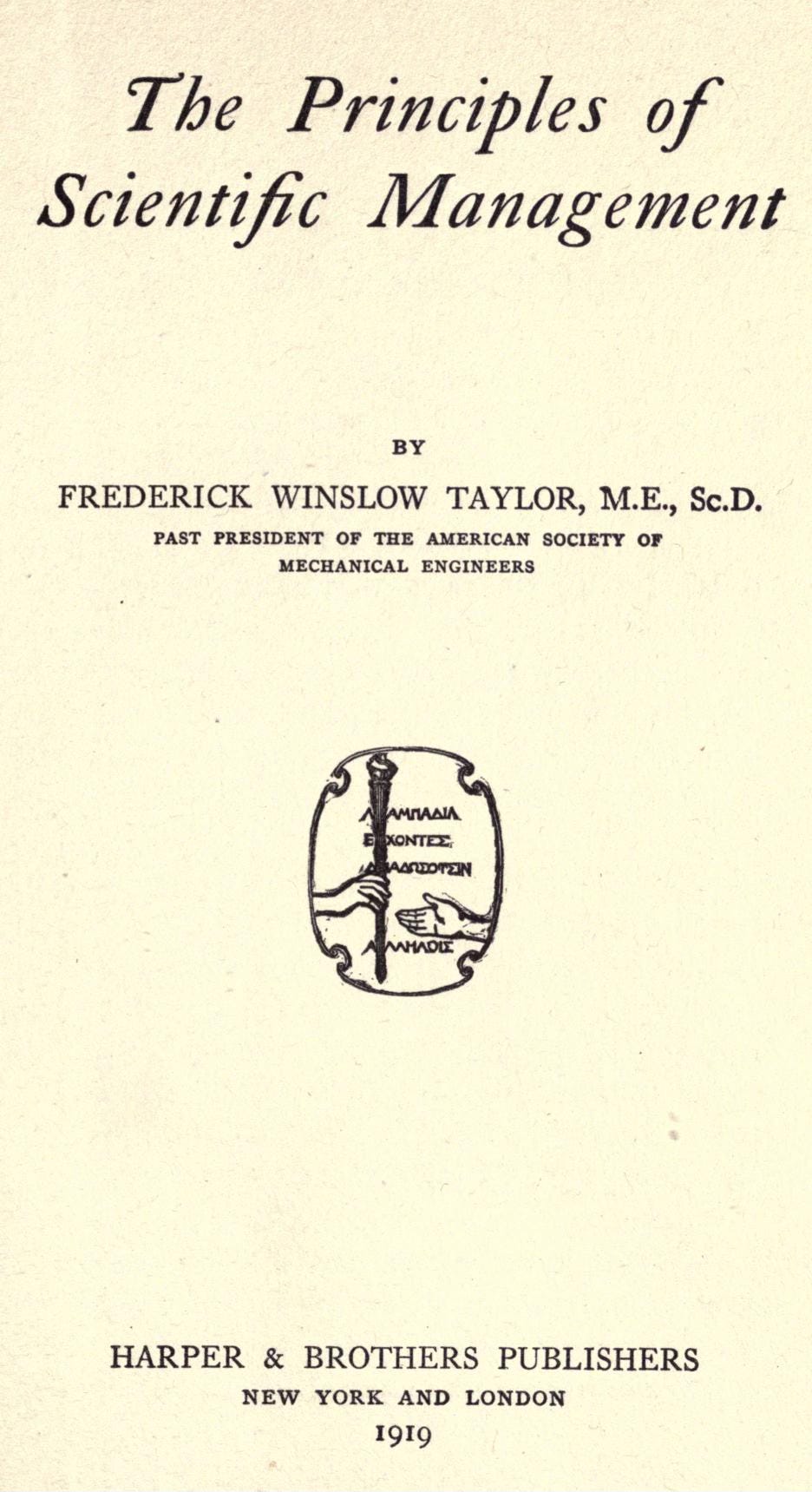
His ideas gained wider exposure through papers, lectures, and consulting work, but his most important statement came in 1911 with The Principles of Scientific Management. The book was concise, forceful, and influential. Taylor argued that the central problem of industrial production was poor organization and management leading to inefficiency. Analysis should replace improvisation. Management should study work scientifically, select and train workers carefully, cooperate closely with labor, and divide responsibility so that planning belonged to management rather than individual workers.
His admirers saw this as an advance in rational organization. But his critics viewed “Taylorism,” as it came to be known, warily. Labor leaders were deeply suspicious. Skilled workers traditionally retained control over important aspects of their labor, including methods and knowledge of production, what we might call trade secrets. Taylor’s system transferred much of that authority and economic power upward. Workers also feared that efficiency gains would not be shared. A faster system could mean higher wages, but it could also mean layoffs and harsher working conditions.
Taylor’s methods also became politically contentious. In 1911 and 1912, congressional hearings examined the use of scientific management, especially in federal facilities like the Watertown Arsenal. Critics charged that stopwatch management dehumanized workers by treating men like interchangeable mechanisms. Taylor defended himself by arguing that scientific management benefited both employer and employee through greater efficiency and higher pay.
Praise and criticism aside, Taylorism became embedded in the structure of America. Henry Ford’s assembly lines reflected similar principles of standardization and workflow optimization, though Ford developed his own system independently. Twentieth-century industrial management broadly embraced time studies, process engineering, production analysis, and efficiency measurement. Later management science, such as operations research, logistics systems, and performance analytics all bore some intellectual trace of Taylor’s influence.
His reach extended beyond factories. Offices adopted standardized workflows. Retail chains optimized labor scheduling. Warehouses tracked movement and output. Software companies measured productivity. Modern white-collar life, despite its greater comfort, often remains deeply Taylorist in instinct. Dashboards, metrics, benchmarks, workflow analysis, and endless optimization all descend in part from the same managerial impulse. The oft-repeated mantra that “if it matters, it can be measured” traces back in spirit to Taylor. That principle has since been applied to nonprofit organizations, government agencies, and even labor unions themselves.

Taylor genuinely believed greater efficiency would benefit society broadly. Industrial waste, in his view, reduced prosperity for everyone. He was not a crude exploiter in the mold of the fictional robber baron. He saw himself as a reformer introducing rational order into disorder. But reformers are not always gentle, and rational systems are not always humane. Frederick Winslow Taylor died in 1915, only a few years after publishing his most famous work. He was fifty-nine years old.
By the time of his death, the world he helped shape had already arrived. The twentieth century would become the age of professional organization, with its mass production, bureaucratic systems, standardized processes, managerial expertise, business schools, consulting firms, and relentless measurement of performance. Taylor gave this world much of the grammar it still uses daily.
Taylor helped unlock astonishing productive capacity. It is undeniable that the application of his methods increased industrial output, allowing for cheaper goods. His methods also rendered organizational systems more reliable. The modern world depends heavily on the efficiencies he championed.
Yet his vision carried a heavy cost. Older forms of work often involved skill, discretion, and personal ownership over one’s craft. Taylor’s system frequently treated labor less as a human vocation than as a technical problem to be solved. Every workplace that prizes metrics over judgment, and every employer that confuses measurement with wisdom, pays that cost. And yet so does every hospital, airline operations center, modern supply chain, and manufacturing plant that depends on disciplined coordination rather than chaos. Is the cost justified? Who would voluntarily step back in time to before Frederick Winslow Taylor?
with gratitude and love—