

Judgment and its Limits

William Rehnquist (1924-2005)
William Hubbs Rehnquist was born in Milwaukee, Wisconsin and his upbringing was middle-class, Midwestern, disciplined, and grounded. His father sold insurance and his mother was politically and civically active. He was raised Lutheran and educated in public schools. After brief service in the Army Air Forces at the close of World War II, he pursued higher education with intensity, studying at Stanford University, Harvard University, and Oxford before returning to Stanford Law School. He graduated first in his class in 1952, a distinction that immediately marked him as one of the most formidable legal talents of his generation. One of his distinguished classmates was future Supreme Court justice Sandra Day O’Connor, to whom he proposed marriage. She declined, however, having already met her future husband.
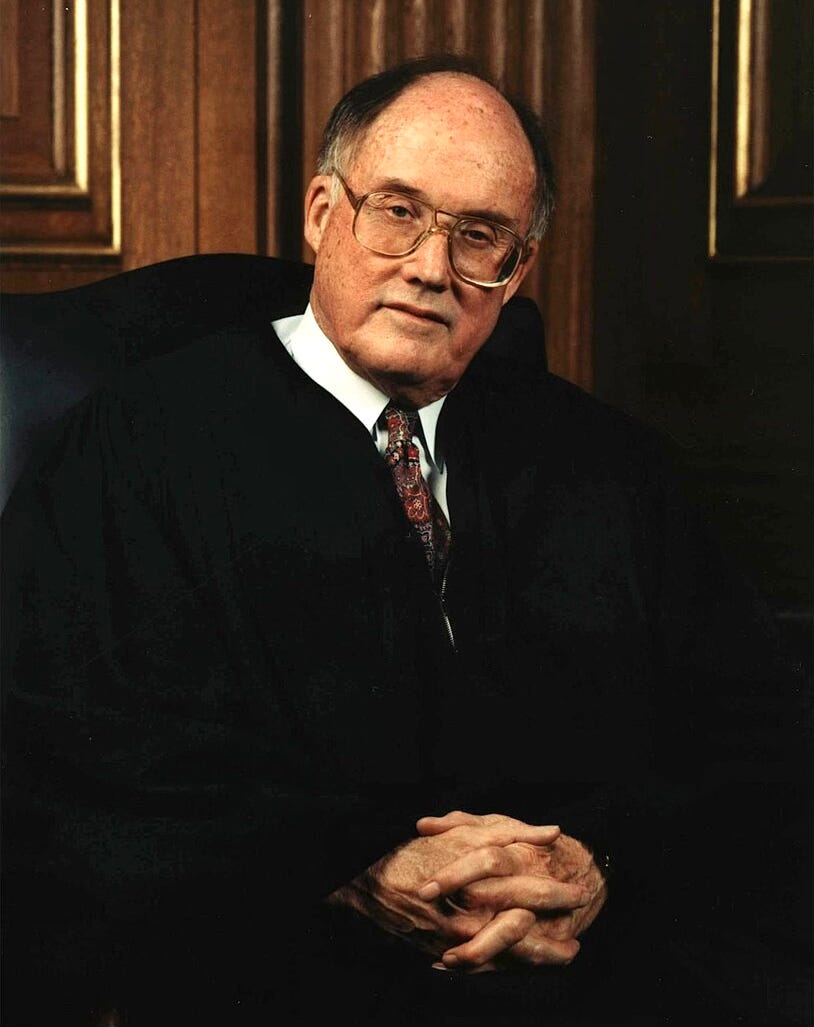
Following law school, Rehnquist clerked for Justice Robert H. Jackson of the Supreme Court. The clerkship proved formative and controversial. During this period, Rehnquist authored a memorandum analyzing the Court’s pending school segregation cases and argued that Plessy v. Ferguson should be affirmed. Decades later, during his 1986 confirmation hearings to become Chief Justice, Rehnquist stated that the memorandum reflected Justice Jackson’s tentative views rather than his own. This account was challenged publicly by Elsie Douglas, Jackson’s longtime secretary, who stated that Rehnquist was mistaken in attributing the position to Jackson.
The historical record, however, is more complex. Papers from Justices William O. Douglas and Felix Frankfurter indicate that Jackson did, at points, express skepticism about the constitutional reasoning underlying Brown, even as he ultimately joined the Court’s unanimous opinion. Those records leave open the possibility that Rehnquist’s recollection was at least partially accurate. The episode remains unresolved, an early illustration of the tension between judicial deliberation, memory, and the certainty that constitutional adjudication often demands.
After his clerkship, Rehnquist entered private practice and later public service, joining the Department of Justice during the Nixon administration. In 1971, President Richard Nixon nominated him to the Supreme Court as an Associate Justice. From the beginning, Rehnquist stood apart. For much of his early tenure, he found himself isolated on the Court, dissenting again and again from prevailing doctrine. He became known as the “Lone Ranger,” a justice frequently writing alone, questioning assumptions others took for granted, and pressing arguments that seemed, at the time, out of step with constitutional orthodoxy.
Rehnquist rejected the jurisprudence of the Warren Court and questioned the legitimacy of constitutional doctrines he believed untethered from text, history, and structure. He was skeptical of substantive due process, wary of judicial innovation, and deeply committed to federalism as a constitutional imperative rather than a policy preference. His dissents were often blunt, even austere, but they were consistent, disciplined, and persistent. Over time, ideas first expressed in solitary opinions would find increasing acceptance. His consistency slowly gained him attention, then admirers.
Rehnquist’s dissent in Roe v. Wade (1973) marked one of the clearest early statements of his constitutional philosophy. He argued that the Constitution contained no textual or historical basis for a right to abortion and criticized the Court for constructing an elaborate regulatory framework under the guise of constitutional interpretation. In his view, the decision displaced democratic choice and substituted judicial judgment for legislative authority. Nearly twenty years later, in Planned Parenthood v. Casey (1992), Rehnquist again dissented, rejecting the plurality’s reliance on stare decisis as insufficient to preserve what he regarded as a fundamentally flawed constitutional holding.
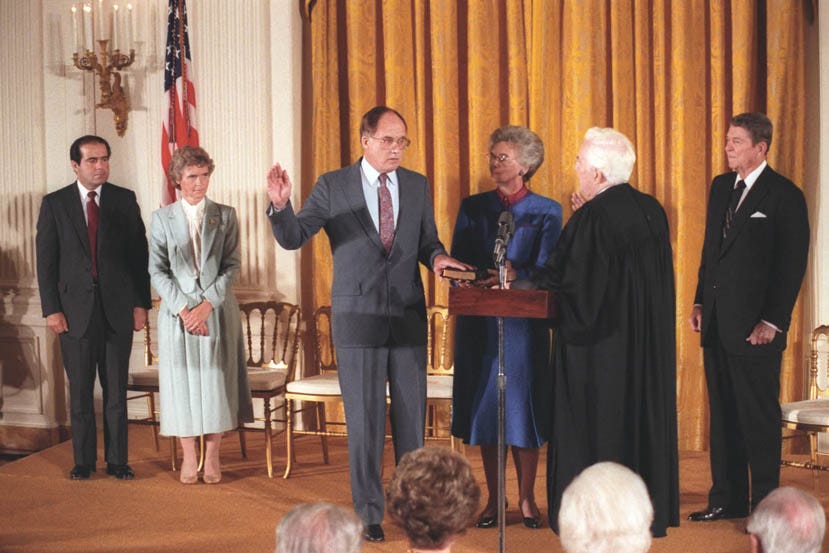
In 1986, President Ronald Reagan elevated Rehnquist to Chief Justice of the United States. As Chief, he proved an effective administrator and an institutional steward. He worked to improve collegiality on a sharply divided Court and presided over a period of gradual but consequential doctrinal change. Under his leadership, positions once confined to dissents increasingly became law. The Court reinforced limits on federal power, revived meaningful enforcement of the Tenth Amendment, and imposed constraints on Congress’s use of the Commerce Clause. Decisions such as United States v. Lopez and United States v. Morrison reflected Rehnquist’s long-standing belief that constitutional structure itself serves as a safeguard of liberty.
Rehnquist’s opinion in Washington v. Glucksberg (1997) exemplified his approach to substantive due process. Writing for the Court, he rejected a claimed constitutional right to assisted suicide, insisting that asserted liberty interests must be carefully defined and deeply rooted in the nation’s history and tradition. The opinion emphasized caution, historical grounding, and limiting principles, reflecting Rehnquist’s concern that abstract appeals to autonomy risked untethering constitutional law from any stable foundation. His fundamental idea was that the people speaking through their legislatures, rather than unelected judges, should decide issues of rights that the constitution does not enumerate, otherwise elective democracy risks overthrow by tyrannical judicial audit.
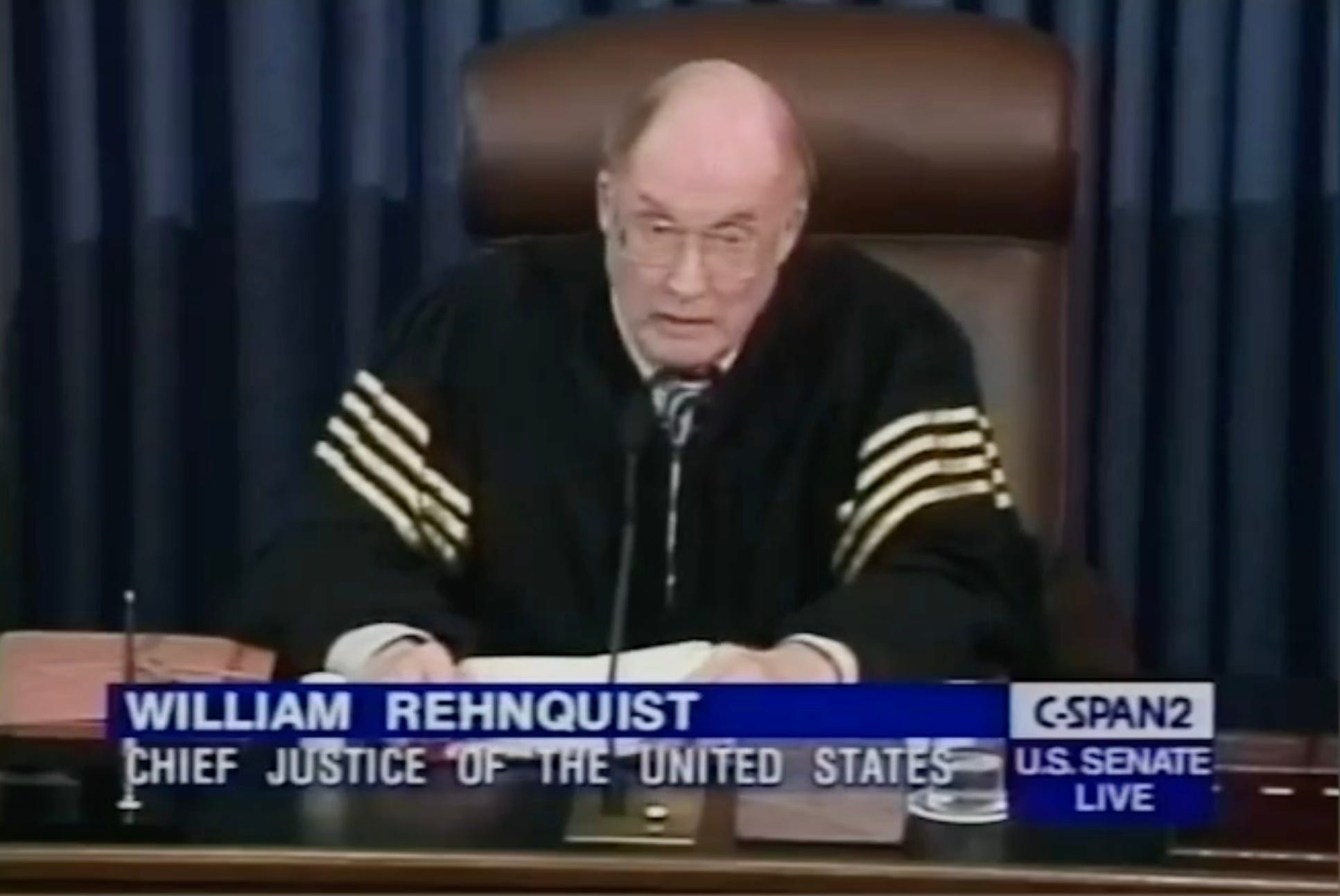
Beyond doctrine, Rehnquist played a visible institutional role. In 1999, he presided over the Senate impeachment trial of President Bill Clinton, carrying out the constitutional duty with procedural rigor and deliberate neutrality. His conduct reinforced his belief that the Chief Justice’s role, even amid political intensity, was to safeguard process.
Rehnquist served as Chief Justice until his death in 2005, becoming one of the longest-serving Justices in the Court’s history. He left behind a body of work defined by skepticism of judicial power, fidelity to constitutional structure, and a willingness to endure long years of isolation in defense of principle.
William Rehnquist’s legacy lies in his insistence that constitutional law is an exercise in authority carefully confined. He believed courts preserve liberty not by expanding their reach, but by honoring the limits of their role. In an era inclined to ask judges for moral resolution, Rehnquist stands as a reminder that constitutional fidelity often begins in dissent, and sometimes ends there, content to have held the line.
Learned Hand (1872-1961)
Learned Hand was born in Albany, New York, in 1872, into a family steeped in law, learning, and public responsibility. His grandfather had served as chief judge of the New York Court of Appeals, and his father was a respected attorney. But Hand’s youth was marked less by confidence than by inwardness. His father died when Learned was fourteen, an event that unsettled him deeply and left him with a lifelong sense of insecurity. He grew into adulthood reflective, hesitant, and self-critical, traits that would later shape his understanding of judging as an act of restraint rather than assertion.
Hand attended Harvard College, studying philosophy and literature before entering Harvard Law School. There he fell under the influence of James Bradley Thayer, whose theory of judicial restraint would become central to Hand’s intellectual life. Thayer taught that courts should invalidate legislation only when its unconstitutionality was clear beyond reasonable doubt. The lesson resonated. Hand came to believe that law was not a forum for moral display but a discipline of limits, one that required judges to subordinate their personal convictions to institutional boundaries. He graduated in 1896 and returned to Albany to practice law, though he found private practice uncertain and unrewarding.
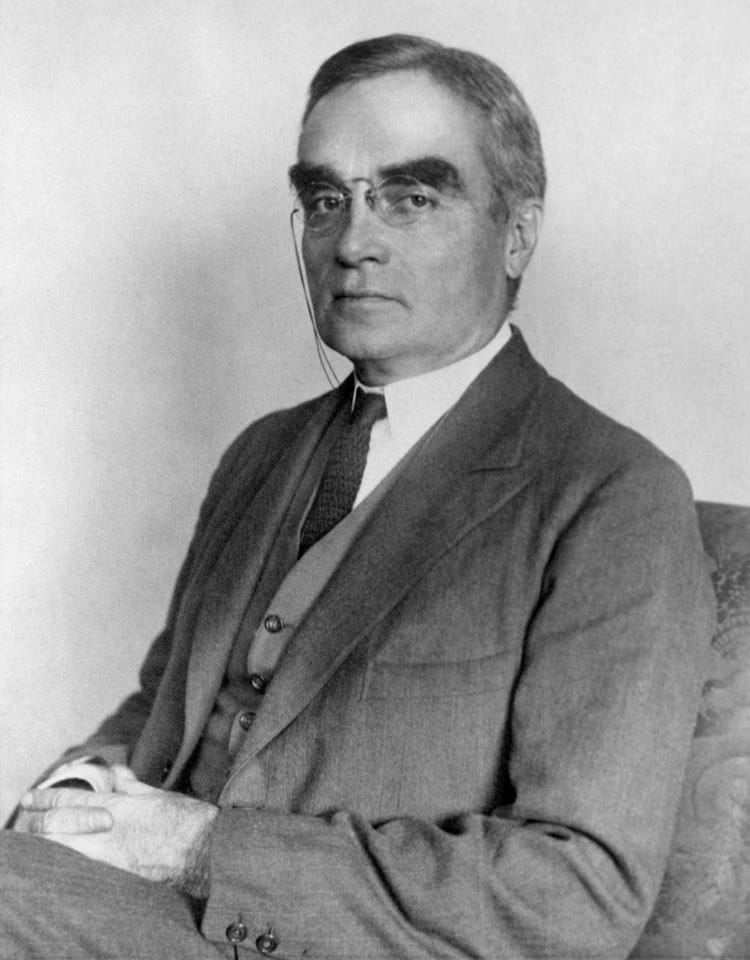
In 1909, President William Howard Taft appointed Hand to the United States District Court for the Southern District of New York. At thirty-seven, he was placed at the center of the nation’s most complex commercial and regulatory disputes at a time when industrialization and federal authority were rapidly expanding. Hand approached the trial bench with meticulous care. His opinions were clear, spare, and carefully reasoned, marked by an unusual literary precision. His reputation grew quietly, built on craftsmanship rather than controversy.
Hand was elevated in 1924 to the United States Court of Appeals for the Second Circuit, where he would serve for the remainder of his judicial career. Though he never sat on the Supreme Court, despite repeated speculation and serious consideration by several administrations, his influence would extend far beyond his formal station. From the Second Circuit, he shaped entire fields of law, producing opinions that were read, taught, and adopted nationwide.
A defining feature of Hand’s jurisprudence was his skepticism toward judicial overreach. He rejected the idea that judges should enforce their own moral or political preferences under constitutional cover. This position placed him at odds with the Lochner-era courts that struck down economic regulation, and later with courts that aggressively expanded substantive rights. In Masses Publishing Co. v. Patten (1917), a case involving antiwar speech under the Espionage Act, Hand articulated a speech-protective standard focused on direct incitement rather than abstract advocacy. Although the decision was reversed, its reasoning anticipated later First Amendment doctrine and reflected Hand’s insistence that legal standards remain objective rather than intuitive.
Hand’s influence extended beyond adjudication into the structure of American law itself. He was a founding member of the American Law Institute in 1923 and played an important role in the early work on the Restatements of the Law. The Restatements were an ambitious effort to clarify, systematize, and rationalize the common law without supplanting judicial development. They reflected Hand’s belief that law should be intelligible, coherent, and disciplined, but not frozen. The Restatements did not claim legislative authority; they aimed instead to distill the best understanding of prevailing doctrine. Their enduring influence in torts, contracts, and property law mirrors Hand’s own judicial philosophy: careful synthesis rather than innovation for its own sake.
Nowhere was Hand’s practical influence greater than in tort law. His opinion in United States v. Carroll Towing Co.(1947) introduced a now-canonical formulation of negligence, weighing the burden of precautions against the probability and severity of harm. The so-called Hand formula was not meant to reduce judgment to arithmetic. Rather, it offered a disciplined framework for thinking about reasonableness in a complex industrial society. It clarified what negligence law had always implied, and for that reason became foundational, taught in every law school in the country.
Hand’s approach to statutory interpretation was similarly measured. He rejected rigid literalism but resisted purposive interpretation untethered from text. Judges, he believed, were translators, not authors. In regulatory cases, his opinions emphasized coherence, institutional competence, and deference to legislative choice. He understood courts as participants in a democratic system they did not create and could not replace.
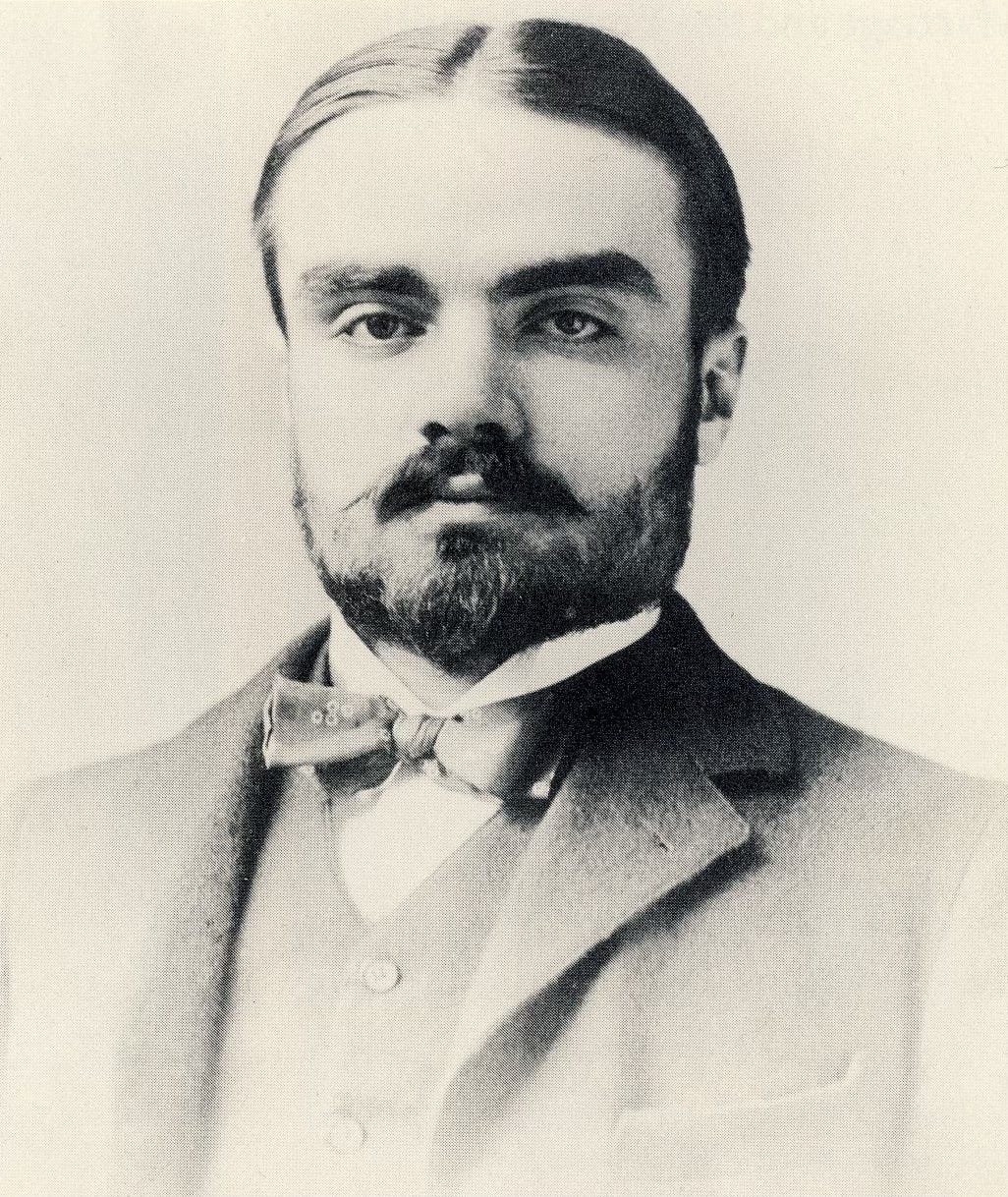
Yet Hand was no cynic. His restraint was moral as well as institutional. In his 1944 address, “The Spirit of Liberty,” delivered during the darkest days of World War II, he warned that liberty lived not in constitutions or courts alone, but in the hearts of men and women. When that spirit died, no law could save it. The speech revealed the ethical core beneath his jurisprudence: law could preserve space for freedom, but it could not manufacture wisdom or virtue.
Hand assumed senior status in 1951 but continued to write and sit by designation well into his eighties. He remained intellectually active until his death in 1961 at the age of eighty-nine. By then, generations of judges and lawyers regarded him as a model of judicial excellence, even as constitutional law moved in directions he might not have embraced.
Learned Hand’s legacy lies less in outcomes than in posture. He showed that judging requires disciplined modesty, that clarity can coexist with doubt, and that fidelity to law often demands the refusal to impose oneself upon it. In an age drawn to judicial certainty, Hand remains a reminder that the authority of courts depends not on brilliance alone, but on humility sustained over time.
With gratitude, and love—