Devising a Stress Test
Questioning assumptions, designing experiments

George Mason and Chien-Shiung Wu
Some people conceive majestic, weightless, flawless theories: Plato’s perfect Forms; Euclid’s geometry; Newton’s mechanics; Locke’s social contract. These ideas have a rare beauty of symmetry and coherence. But elegance alone does not govern nations or describe nature. Until tested by reality, these ideas remain simply air and hope.
It takes genius to imagine a perfect theory. It takes a different kind of greatness to stress test; to question its assumptions, and to insist that it survive contact with the real world. Progress depends as much on these testers as on the dreamers.
George Mason and Chien-Shiumg Wu did their most important work at precisely this touchpoint. Each confronted a reigning theory that was widely admired, confidently held, but insufficiently tested. Each refused to accept the elegance of the theory, and each identified a fatal omission at the heart of their respective systems (one moral the other physical) that forced a reckoning. They did not destroy, but rebuilt theories. Their legacies remind us that disciplined skepticism and careful testing are not obstacles to progress, but its necessary companions.
George Mason (1725-1792)
George Mason understood power too well to trust it to theory alone. A Virginian planter steeped in English constitutional history, he admired the ingenuity of the proposed Constitution but distrusted its silences. He is remembered today chiefly as one of the few delegates who refused to sign the final document in Philadelphia, and thus one of the principal “Anti-Federalists”.
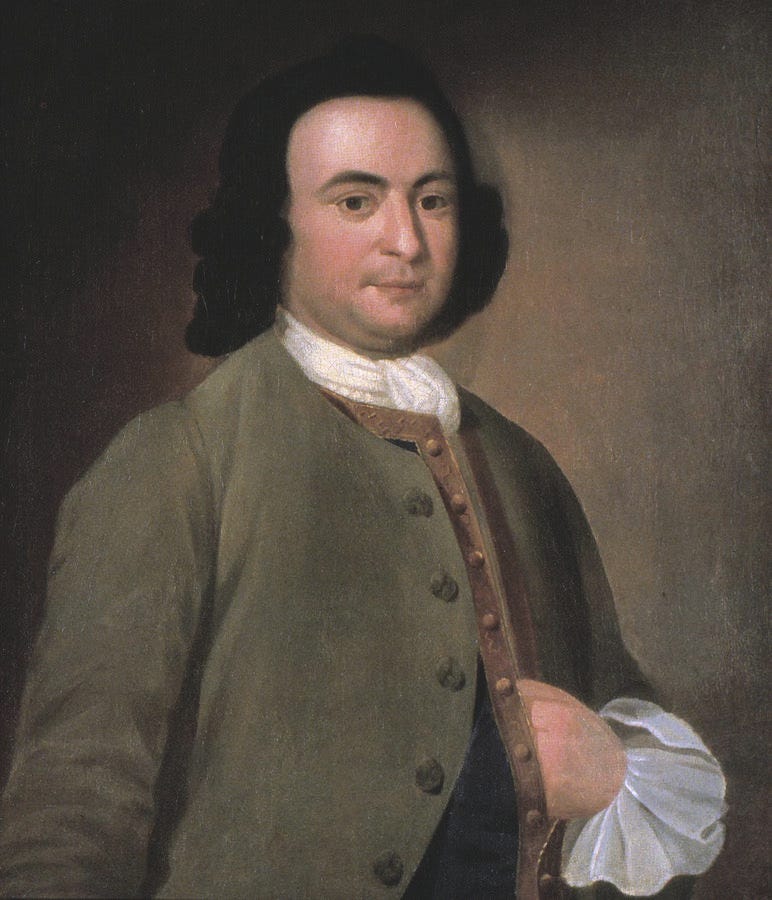
Mason’s objection was simple and devastating: the Constitution lacked a bill of rights. Without explicit protections for conscience, speech, press, jury trial, and due process, the elegant machinery of checks and balances would not suffice. Power would accumulate. The central government would grow. And over time, the uncontrolled, distant regime would oppress.
“There is no Declaration of Rights,” Mason warned, opening his Objections to This Constitution of Government in September 1787. The absence, he argued, rendered the entire structure unstable. The Revolution itself had been fought to secure concrete liberties, not merely to rearrange institutions. What was the point of independence if the rights for which it was won were left undefined?
Mason’s critique struck hard. Madison and Hamilton responded by insisting that the federal government could exercise only those powers expressly granted to it, and therefore posed no threat to liberty. But this was unconvincing beside Mason’s plain insistence that rights must be named, written, and enforced. Madison and Hamilton eventually conceded and Virginia ratified the Constitution only narrowly, and only on the express understanding that amendments protecting individual liberties would follow.
They did. James Madison drafted them. The first ten amendments—the Bill of Rights—became the moral ballast Mason had demanded. He did not live long enough to see their full adoption, but the world did not miss the lesson. Revolutionary France soon issued its Declaration of the Rights of Man and of the Citizen. More than a century later, the United Nations’ Universal Declaration of Human Rights would echo the same architecture. Mason’s insight traveled farther than his name.


Yet Mason’s relationship with liberty was ambivalent. He condemned slavery in unusually stark terms for his era, calling it a “slow poison” that corrupted both master and republic. He opposed the continuation of the transatlantic slave trade at the Constitutional Convention and correctly predicted that the institution would one day imperil the Union itself. And yet, he never freed those he himself enslaved.
This contradiction matters. Mason’s moral imagination exceeded his personal action. He stood ahead of his time—but not far enough ahead. Like the founding itself, his legacy is both principled and unfinished. Still, Mason saw what others would not: that the Constitution, for all its brilliance, was not yet good enough. He said so plainly. And he was right.
Chien-Shiung Wu (1912–1997)
Chien-Shiung Wu came to the United States from China in the 1930s to study physics, initially enrolling at the University of Michigan. She encountered a culture of sexism. Women were barred from certain facilities and required to enter others through side doors. Unwilling to accept this, Wu transferred to the University of California, Berkeley. There she found not only access, but excellence: mentors, resources, and rigor. Among her teachers were Emilio Segrè and Ernest Lawrence, both future Nobel laureates.
Wu earned her PhD in 1940. Ernest Lawrence strongly recommended her for a faculty position, but in wartime America academic posts were scarce. After a few years working as a post-doctoral research she accepted a position at Princeton—the first woman ever appointed to its physics faculty—but was confined largely to teaching.
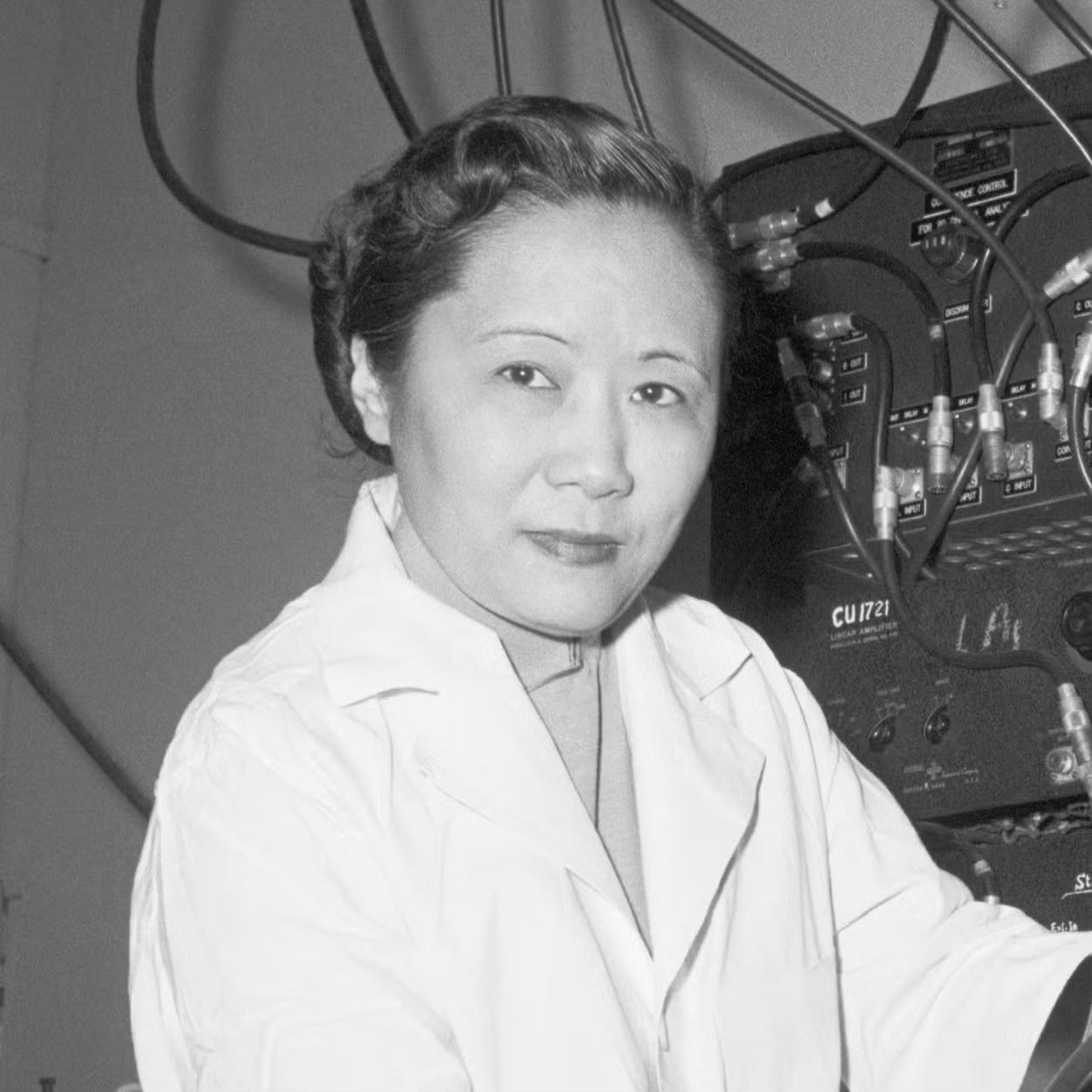
In 1944, Wu left Princeton to join the Manhattan Project. The move was less ideological than practical; it was one of the few places where she could use her skills. The decision proved serendipitous. Shortly after her arrival, Enrico Fermi encountered a destabilizing problem in the world’s first nuclear reactor: the unexpected accumulation of xenon-135 which threatened to shut the reactor down. Segrè, hearing of the difficulty, urged Fermi to “ask Ms. Wu.” Wu’s dissertation (still unpublished during wartime for security reasons) was devoted precisely to xenon isotopes. She fixed it. She also contributed to uranium enrichment modeling and to the development of reliable Geiger counters.
After the war, Wu joined Columbia University as a research professor and, in 1952, became the first woman to receive tenure in physics at a major American university. It marked the beginning of a legendary career. Early on, she confirmed quantum-mechanical predictions involving entangled protons, work closely related to the Einstein–Podolsky–Rosen thought experiment. She later conducted some of the earliest experimental tests related to Bell’s inequalities, reinforcing the conclusion that quantum mechanics violated classical assumptions about locality and realism.
Her greatest achievement came in 1957 with what is now known as the Wu experiment. For decades, physicists had embraced a principle called parity conservation. This is the idea that the laws of nature make no distinction between left and right. The assumption was elegant, intuitive, and unchallenged. It had been experimentally confirmed for gravity, electromagnetism, and the strong nuclear force. No one had seriously tested whether it applied to the weak nuclear force, responsible for radioactive decay.
Two theorists, Tsung-Dao Lee and Chen-Ning Yang, questioned the assumption. Their calculations suggested parity might fail in weak interactions, particularly in the beta decay of cobalt-60. Wu asked nature directly. By cooling cobalt-60 to near absolute zero and aligning nuclear spins with a strong magnetic field, she created conditions where left and right could be meaningfully distinguished. The result was unambiguous. Electrons were emitted asymmetrically. Nature violated parity.
The shock was immediate. A foundational assumption collapsed overnight. Physics textbooks were rewritten. The weak force was revealed to be fundamentally different from the others—a distinction that later proved essential to understanding matter–antimatter asymmetry and the structure of the universe itself.
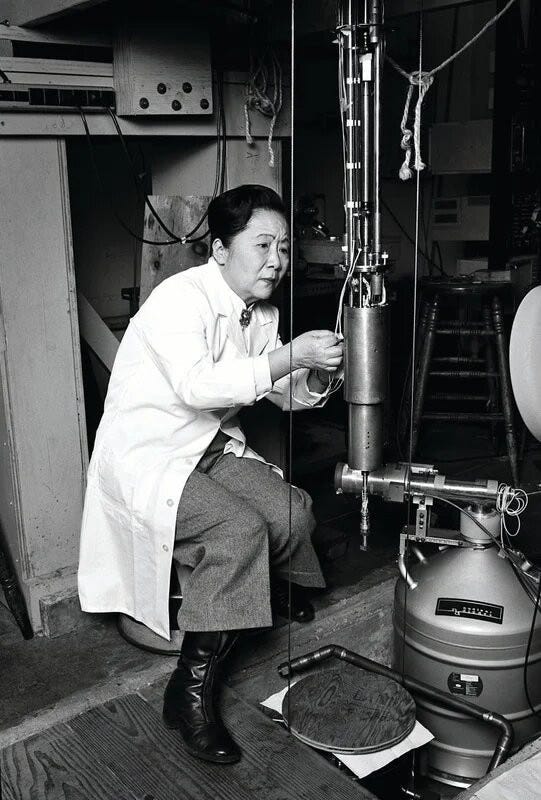
Lee and Yang received the 1957 Nobel Prize in Physics. To their credit, they publicly called for Wu to be included. She never was. Despite more than twenty nominations, the prize passed her by, perhaps the greatest injustice in the prize committee’s history. She did, however, become the first recipient of the Wolf Prize in Physics, serve as the first female president of the American Physical Society, and advocate for science policy reforms that later shaped the White House Office of Science and Technology Policy.
In her later years, Wu spoke with clarity about gender inequality in American science and encouraged young women to enter science through the front door as all Americans should.
With gratitude, and love—