

Defining the Republic
95. Noah Webster

Noah Webster (1758–1843)
One of the great arguments of history is whether the Revolution transformed American society, and if so, how and to what degree. In many ways, it changed everything. Americans no longer had a king. They chose their own leaders. They established a continental republic founded upon liberal democratic principles. But in other ways, nothing changed. Fundamentally, they were still the same people. They prayed in the same churches, studied in the same schools, traded the same goods, and spoke the same language.
At least, they thought they spoke the same language. In truth, English varied widely. Spelling differed from town to town, and usage continued to follow local custom or British precedent. Books still came from London. The language of law, commerce, and education still leaned outward, across the Atlantic. The Republic, if it was to endure, required more than constitutions and elections. It required a common medium of thought. The former colonies had forged a shared political destiny, but they still had work to do in honing a united voice. Noah Webster undertook that work.
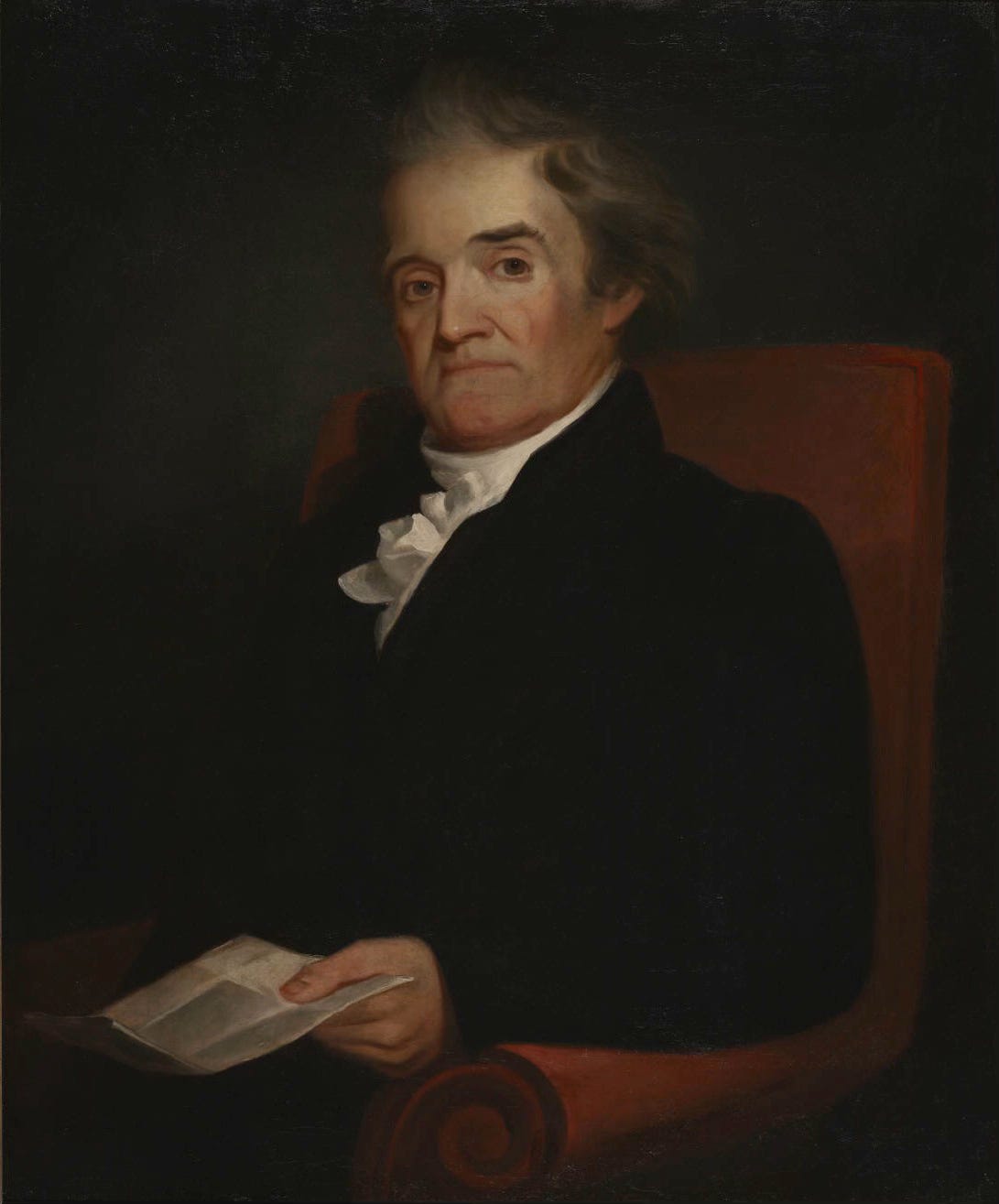
He was born in 1758 in West Hartford, Connecticut, into a modest Yankee home. Piety, discipline, and agrarian simplicity were fundamental. But his family was neither obscure nor provincial. His father was a militia captain, trader, deacon, and justice of the peace. His mother descended from colonial governors. Both parents stressed learning and civic engagement, as good Congregationalists would. And like good Congregationalists, steeped in scripture and sermon, language was weighty. Learning was treasured, and words were never idle; they carried the message of scripture, instruction, and law.
Webster entered Yale College at sixteen, during the unsettled years of the Revolution. The war intruded upon his studies, but at that young age he enthusiastically supported the cause. At times, British forces threatened nearby towns, and the rhythms of academic life gave way to the uncertainties of conflict. Yet Yale also exposed Webster to the intellectual ways of the colonies, still deeply rooted in English tradition. He read widely, but he also noticed a tension. Americans had declared independence, were dying for it, but they continued to think and write like Englishmen. The young republic, in his view, risked remaining intellectually subordinate despite its independence.
After graduating in 1778, Webster turned to teaching, but what he found in the classroom alarmed him. There was no uniform system of instruction. Spelling books varied. Teachers relied on imported texts that reflected British usage. Students learned inconsistently, and often poorly. Education lacked coherence. If republican government depended upon an informed citizenry, then this was no small defect. Webster’s response was to write.
In 1783, he published the first part of what would become his famous American Spelling Book. He intended it not merely as a teaching tool, but as a standard. Webster simplified spelling where he could, favoring clarity and consistency. He preferred “color” to “colour,” “center” to “centre,” and “defense” to “defence.” These were not trivial changes. They were deliberate acts of linguistic independence. By shaping how Americans learned to spell, Webster sought to shape how they thought of themselves. A distinct language, even in its smallest details, would reinforce a distinct national identity.
The Spelling Book succeeded beyond expectation. It became one of the most widely used textbooks in American history, selling millions of copies over the decades. Generations of children learned to read and write from its pages. In classrooms across the country, from New England villages to frontier settlements, Webster’s system took root. The book did more than teach literacy. It created uniformity. It gave Americans a shared foundation in language. Yet Webster’s ambitions extended further. He did not intend merely to standardize spelling. He aimed to codify and define the entire language of the nation.
In the years following the success of his spelling book, Webster turned to lexicography. Dictionaries existed, of course, most notably those produced in England. But Webster believed they were insufficient for Americans. They reflected how the British spoke. The American experience, shaped by different landscapes, institutions, and habits of life, required its own account. Words in America carried meanings that were not always identical to their English counterparts. New terms had emerged, and old terms had shifted. The language itself was adapting to the conditions of a new world.


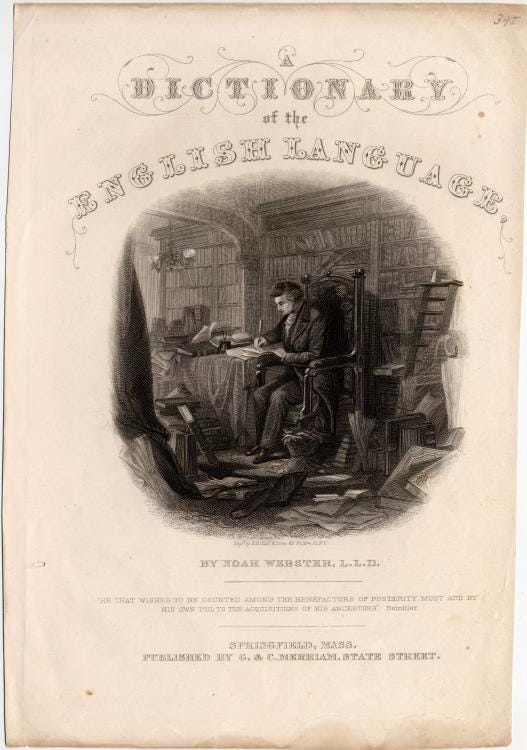
In 1828, after years of preparation, he published An American Dictionary of the English Language. It was a monumental achievement. Containing tens of thousands of entries, many of them defined with an eye toward American usage, the dictionary represented the most comprehensive effort yet to gather and describe the language as it was spoken in the United States. Webster’s definitions often carried a moral dimension, reflecting his conviction that language and character were closely linked. Words, in his view, were not neutral. They shaped thought and thought shaped conduct.
The dictionary did not immediately displace its British counterparts, but it established a new standard. Over time, Webster’s work came to dominate American lexicography. His name became synonymous with the dictionary itself; indeed, it still appears on the dictionary. More importantly, his approach reinforced the idea that the United States possessed not only political independence, but intellectual and cultural autonomy.
Webster’s career was not confined to education and lexicography. He was also an active participant in public life. He wrote essays on politics, supported the Constitution, and aligned himself with the Federalist vision of a strong national government. He believed that unity was essential to the survival of the nation, and he saw language as one of the principal means of achieving it. A common language would bind the states together, facilitate commerce, and enable the exchange of ideas across distances that were, in his time, considerable.
Webster’s ideas drew controversy in his day. Some critics resisted his spelling reforms, seeing them as unnecessary. Others took issue with his political positions or his moral tone. Webster himself could be combative, and he did not shrink from intellectual disputes. Yet even his critics could not deny the scale of his contribution.
By the time of his death in 1843, the United States had grown in population, territory, and confidence. It had begun to develop its own literature, its own institutions, and its own habits of thought. The language spoken by its people, while still English, bore the marks of that development. It was more standardized, more distinctly American, and more widely shared than it had been in the uncertain years after independence.
Webster did not create that transformation alone. Language evolves through use, through countless acts of speaking and writing across generations. But he formalized that change. He imposed a measure of order on what might otherwise have remained diffuse and unsettled. He provided tools that allowed Americans to learn, to communicate, and to understand one another with greater clarity. In a republic, such work is foundational.
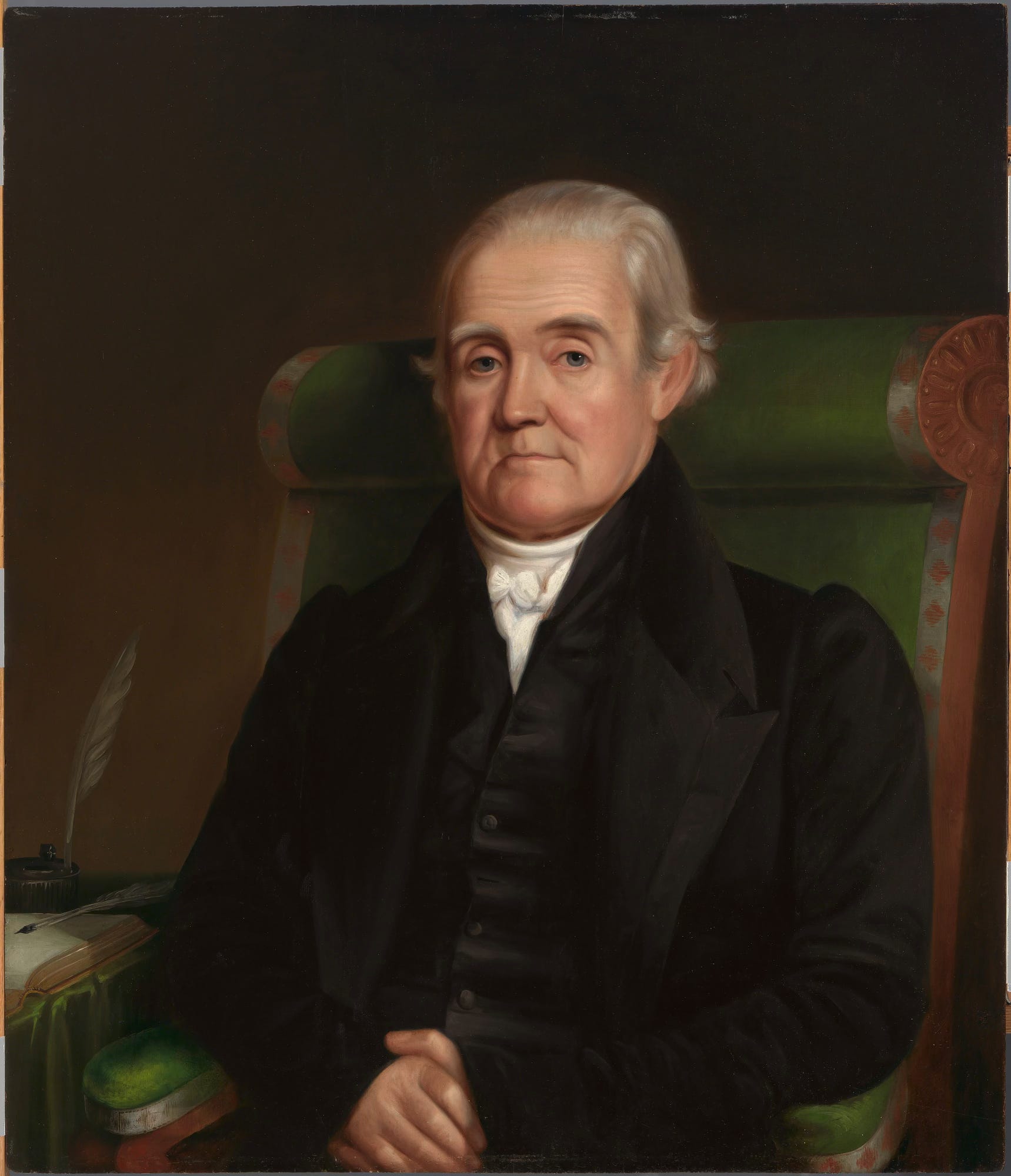
Webster understood this with unusual clarity. He saw that independence, to endure, had to be cultivated in the habits of everyday life. It had to be taught to children. It had to be written into books, even reference books. It had to be spoken aloud. His spelling book and his dictionary were instruments of that cultivation. Noah Webster looked at a nation that had secured its independence and saw that something essential remained unfinished. He set himself to the task of finishing it and gave the Republic a language more fully its own.
with gratitude, and love—