

Breaking Open the Sky
Across the Ocean, To the Moon

Amelia Earhart and Alan Shepard
Amelia Earhart (1897-1937)
Nothing from Amelia’s family suggested she would one day break the sky. She was born in 1897 in Atchison, Kansas, into a family that was respectable but unstable. Her father, Edwin, was a railroad claims agent whose alcoholism steadily eroded his professional standing and eventually the family’s social position. Her mother, Amy, resisted convention and encouraged young Amelia and her younger sister to climb trees, keep scrapbooks of newspaper clippings about women in male-dominated professions, and subvert the expectations that confined girls to ornamental roles. The family moved often, following Edwin’s uneven employment from Kansas to Iowa to Illinois. Instability marked her childhood, but so did a quiet and stubborn defiance.
Earhart did not at first burn for the sky. As a very young girl she saw a prototype plane at a fair and was unimpressed by the inelegant machine. During the First World War she served as a nurse’s aide in Toronto, tending wounded soldiers returning from the Western Front. There she saw broken bodies and heard stories of mechanized slaughter. Aviation, still primitive and dangerous, flickered at the edges of her awareness. But in 1920, at an air show in Long Beach, California, she took a brief flight with pilot Frank Hawks. The ten minutes aloft altered the trajectory of her life. She later said that as soon as she left the ground she knew she had to fly. It was as if she had wings her whole life that she only then discovered.
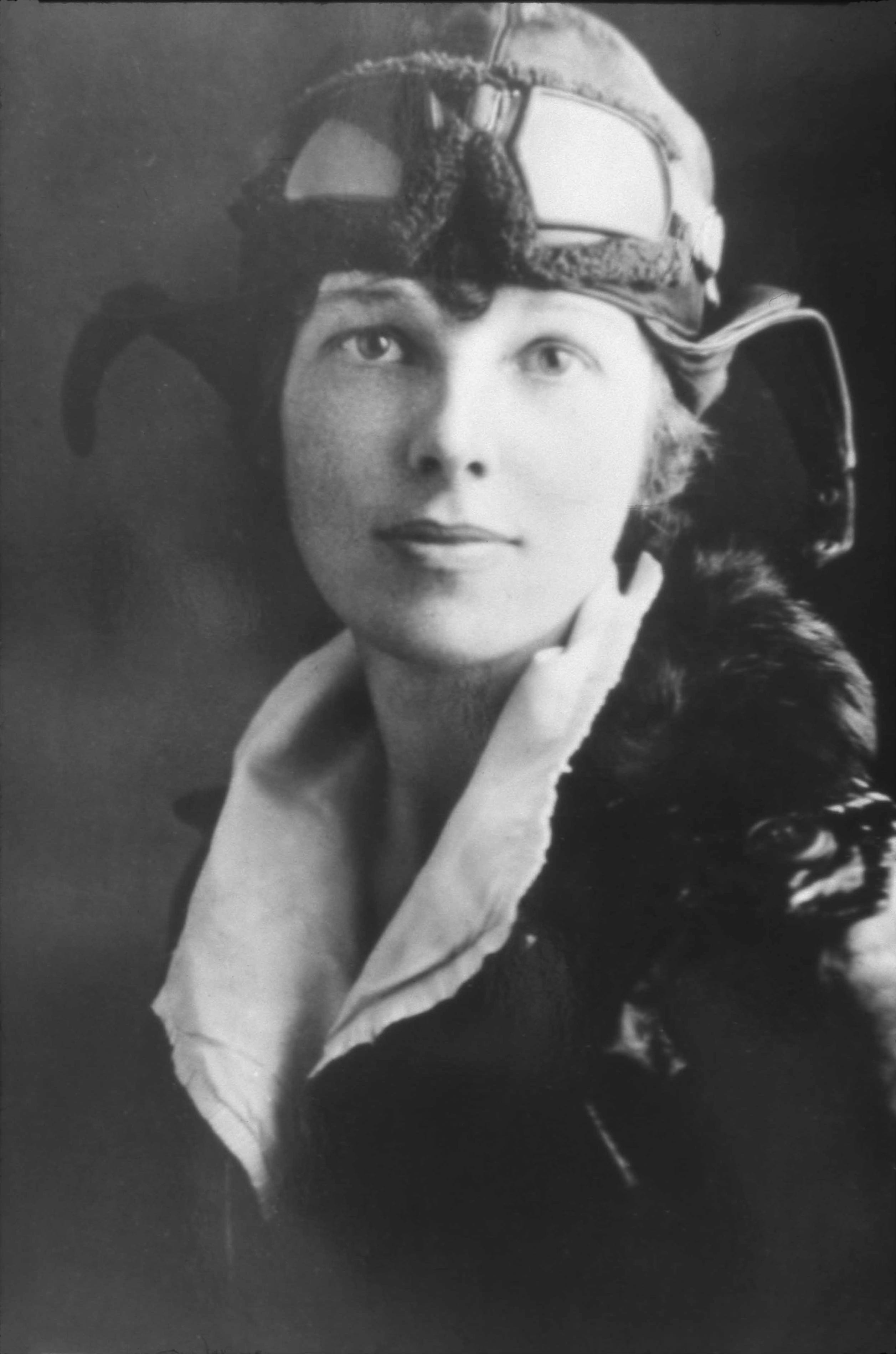
She worked odd jobs, saved carefully, and in 1921 purchased a secondhand Kinner Airster biplane she nicknamed “The Canary.” Under the instruction of Anita Snook, one of the few female flight instructors in the country, she learned the mechanics, art, and discipline of flight. In 1922 she set a women’s altitude record of 14,000 feet. Financial pressures forced her to sell her plane the following year, and for a time aviation receded as she worked as a social worker in Boston to make ends meet. But she did not relinquish the sky. She continued to strive, honing her skills and working to fly.
Her public ascent began in 1928 when she was invited to join a transatlantic flight as a crewmember aboard the Fokker F.VII Friendship. Piloted by Wilmer Stultz, with Louis Gordon as co-pilot and mechanic, the aircraft crossed from Newfoundland to Wales. Earhart kept the flight log and endured the Atlantic, but she did not pilot the aircraft. Even so, the press proclaimed her the first woman to cross the Atlantic by air. She accepted the attention, though privately she insisted she had been little more than baggage, a “sack of potatoes” in her words. She resolved to earn the acclaim she had been given.
In May 1932 she did so. Flying solo in a red Lockheed Vega 5B, she departed Newfoundland and aimed for Paris, following the path of Charles Lindbergh. Mechanical problems and deteriorating weather forced her to land in a pasture in Northern Ireland after nearly fifteen hours in the air. She became the first woman to fly solo across the Atlantic and only the second person to accomplish the feat. Congress awarded her the Distinguished Flying Cross. It was not a symbolic gesture. The flight demanded courage, technical skill, endurance, and composure in isolation.


From the late 1920s through the early 1930s she accumulated further records: the first woman to fly solo nonstop across the United States, the first to fly solo from Hawaii to the mainland, and the first person to fly solo from Los Angeles to Mexico City and onward to Newark. She co-founded The Ninety-Nines, an organization for female pilots, and accepted a position at Purdue University to counsel women on careers. She married publisher George Putnam in 1931, but not before sending him a letter insisting on a partnership of equals. Her life was public, but she guarded her independence.
In an age of mass culture, she had become a celebrity, and she knew how to cultivate her image. She also knew how to use that image for larger goals. Her passions were promoting the science of aviation and the independence of women. Even as she pushed herself to improve her technical skills as an aviator, she expanded both the field itself and the space available to women within it.
In 1937 she turned to her most ambitious project: a circumnavigation of the globe along an equatorial route, longer and more demanding than previous attempts. Flying a Lockheed Model 10 Electra with navigator Fred Noonan, she departed Miami in June. They reached Lae, New Guinea, after traversing South America, Africa, India, and Southeast Asia. The tour was a media sensation, followed closely in the global press and by her admirers worldwide.
On July 2 Earhart and Noonan departed Lae for Howland Island, a small speck in the Pacific that required precise navigation. Radio transmissions indicated confusion about position and dwindling fuel. Then the radio fell silent. Despite an extensive search by the United States Navy, neither Earhart nor Noonan was found, nor was the wreckage of their Electra. Her disappearance fixed her in legend. Conjectures multiplied in the public imagination: did they crash and sink, survive as castaways, or fall into Japanese custody? But the overwhelming fact remains that a disciplined pilot, after years of calculated risk, vanished over open ocean.
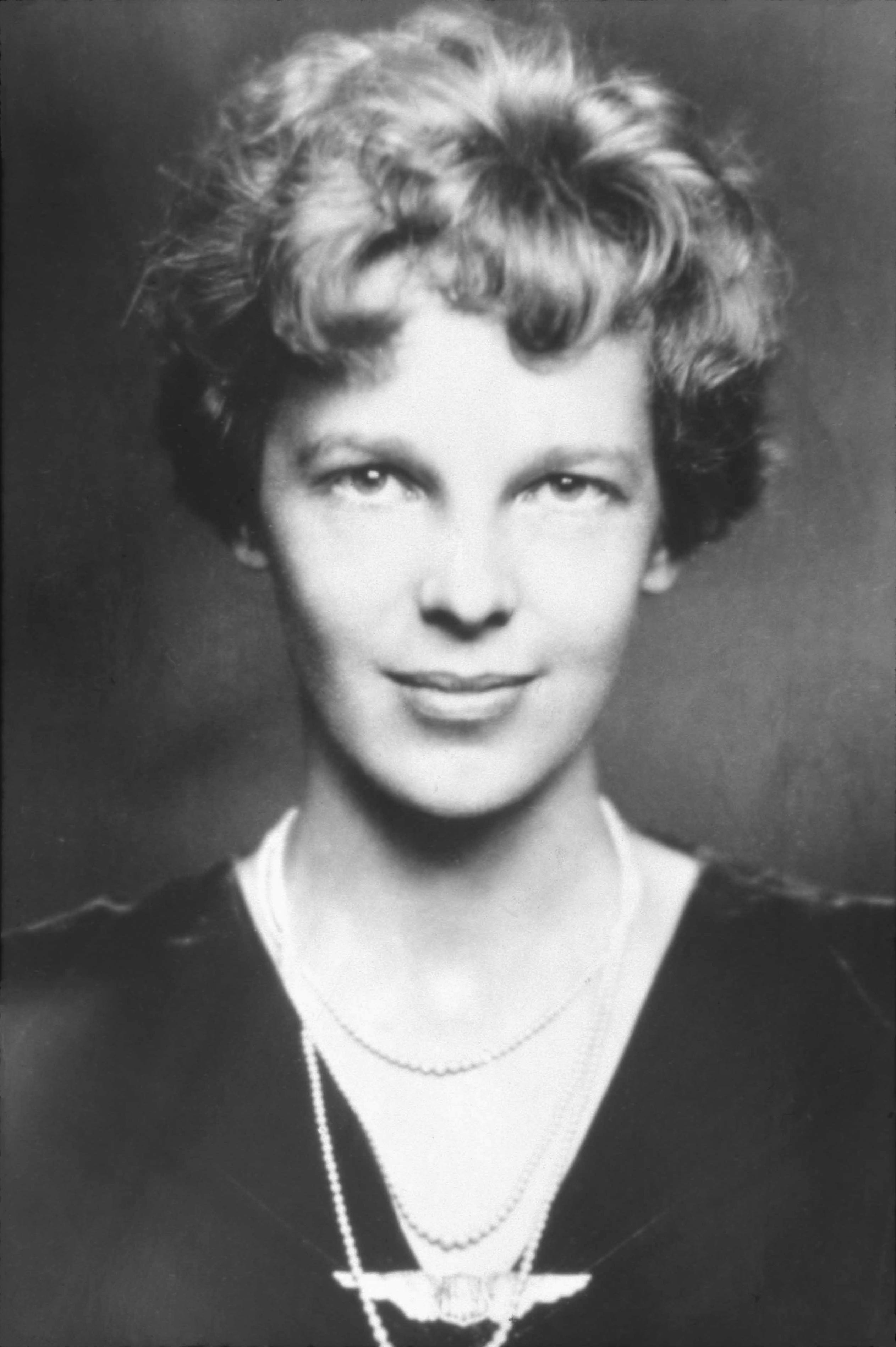
What remains certain is the arc of her life. She mastered a new technology in its infancy. She navigated public expectation without surrendering to it. She insisted that competence, not merely novelty, justified her place in the cockpit. In an era that narrowed horizons for women, she enlarged them through example. Although she never finished her final flight, she completed her labor of breaking open the sky.
Alan Shepard (1923-1998)
The first American to fly into space was born in Derry, New Hampshire. His grandfather owned the local bank. His father worked in that bank as well but also served as an Army officer in both World War I and World War II. Discipline and duty framed young Alan’s childhood, as they would his career. He attended the United States Naval Academy, graduating in 1944 as the Second World War pressed toward its final campaigns. Commissioned into the Navy, he served in the Pacific aboard a destroyer, then turned to naval aviation after the war. By 1947 he had earned his wings as a naval aviator.
Shepard’s early career unfolded in the demanding and dangerous world of carrier aviation and test piloting. He trained at the U.S. Naval Test Pilot School at Patuxent River and became known for technical precision and a competitive temperament. He flew high-performance jets at a time when speed and altitude records were being rewritten. The limits were unknown, and the Cold War sharpened the stakes. Aviation was no longer merely commercial or military. It was geopolitical and civilizational in its implications.
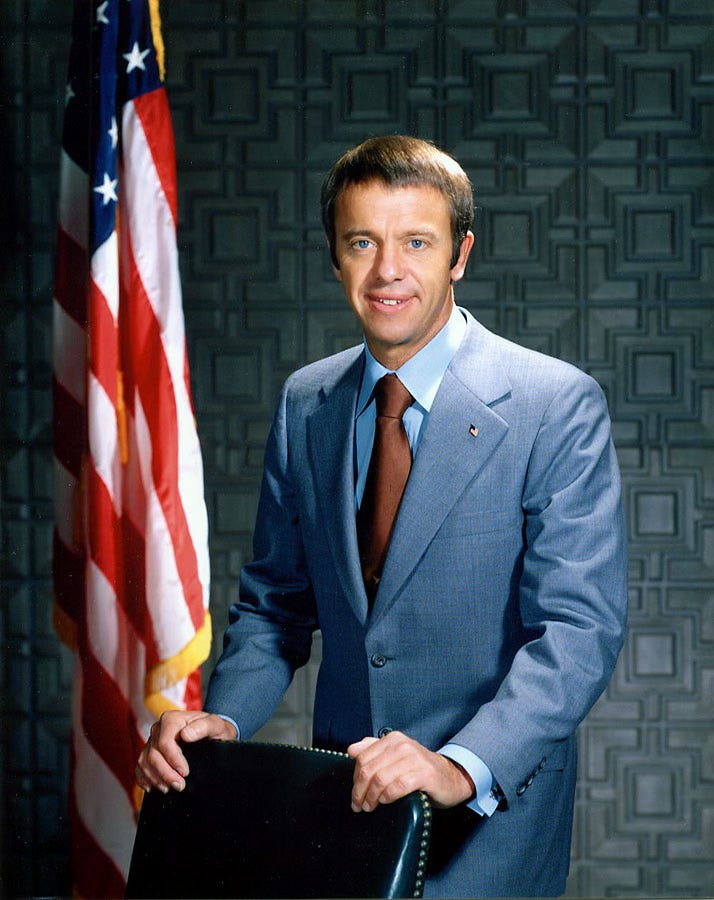
On October 4, 1957, the Soviet Union launched Sputnik 1, the first artificial satellite, into orbit. An entirely new dimension and frontier of technical and even spiritual competition had begun. The Cold War had led to the Space Race, and America was behind.
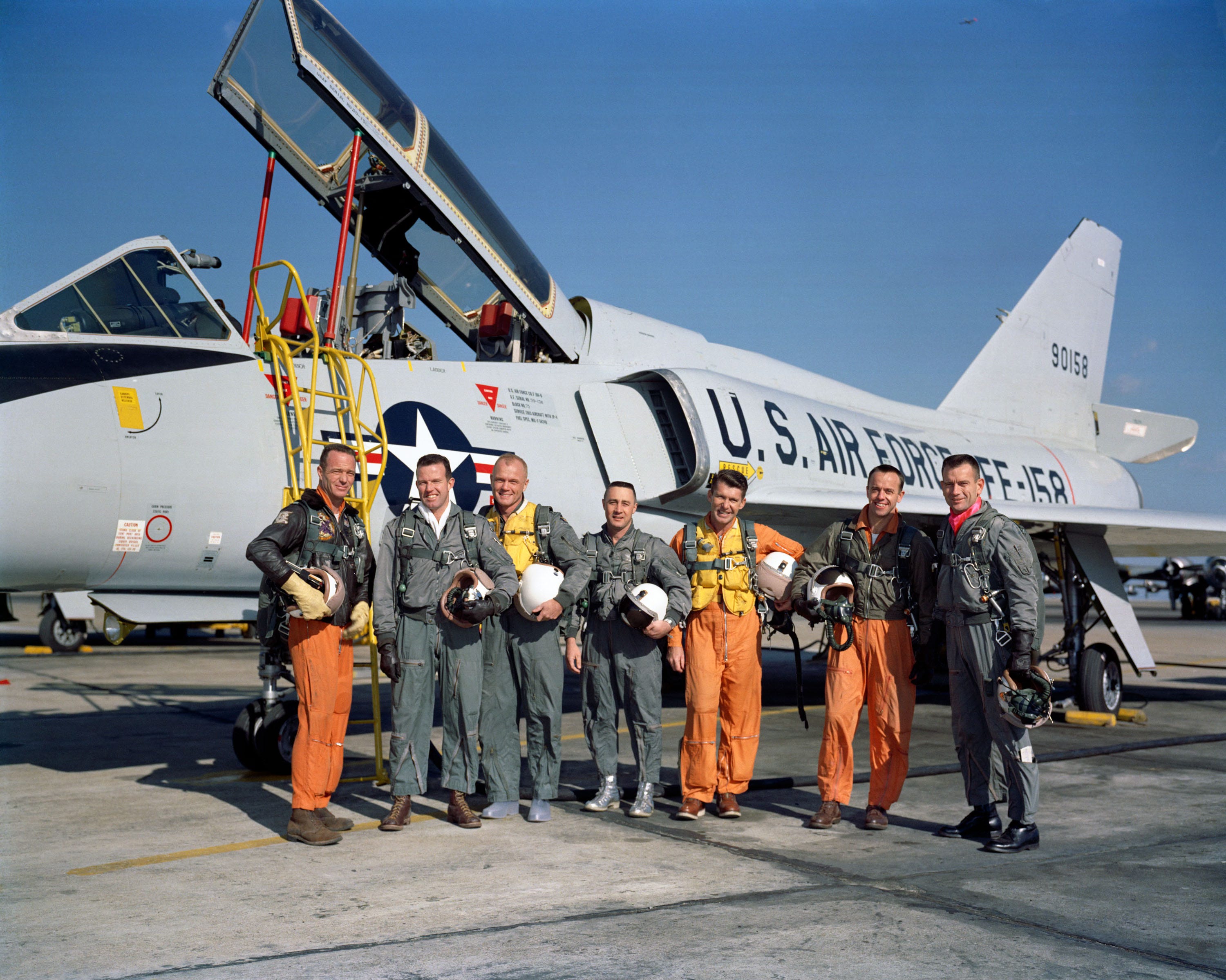
In response, in 1959 NASA selected seven men for Project Mercury, the first American effort to place a human in space. Shepard was among them. The “Mercury Seven” were test pilots by design. They were comfortable with risk, but also with exacting protocols and collaboration with teams of engineers and managers. They were exactly the type of pilots NASA could shape into something new: astronauts. After the Soviet Union launched Yuri Gagarin into orbit in April 1961, the United States moved quickly. On May 5, 1961, Shepard climbed into the Freedom 7 capsule atop a Redstone rocket at Cape Canaveral. He would answer the USSR’s challenge and become the first American to leave Earth and enter space.
The flight was suborbital and lasted just over fifteen minutes. Freedom 7 reached an altitude of 116 miles and traveled downrange before splashing into the Atlantic. Shepard became the first American in space. Unlike Gagarin, Shepard manually controlled portions of the flight, demonstrating that a human pilot could function effectively beyond the atmosphere. The mission did not match Gagarin’s orbital achievement, but it marked an essential step. The United States had entered the arena. More important, humans could pilot spacecraft, not merely ride in them.
Shepard expected to command an orbital Mercury mission, but medical issues intervened. In 1963 he was diagnosed with Ménière’s disease, a disorder of the inner ear that caused vertigo and disorientation. He was grounded from flight status and reassigned to administrative roles within NASA, including Chief of the Astronaut Office. In that position he influenced crew assignments and training during the Gemini and early Apollo programs. For several years, however, he remained earthbound while others flew. Nonetheless, he provided vital contributions to the success of the astronaut program as Gemini and then Apollo advanced the American flag into orbit and onto the Moon.
In 1968 he underwent an experimental surgical procedure that alleviated his symptoms. Restored to flight status, he was assigned to command Apollo 14. By then the Apollo program had endured triumph and catastrophe, including the fire that killed three astronauts during a ground test and the near-disaster of Apollo 13. Apollo 14 launched on January 31, 1971, with Shepard as commander, Stuart Roosa as command module pilot, and Edgar Mitchell as lunar module pilot.
On February 5, Shepard and Mitchell landed the lunar module Antares in the Fra Mauro highlands. Shepard, at forty-seven, became the fifth human to walk on the Moon and the only Mercury astronaut to do so. He also became the oldest man ever to walk on the Moon. During the mission he conducted geological experiments and helped deploy scientific instruments. In a moment both informal and revealing, he used a makeshift six-iron head attached to a sample tool handle to strike two golf balls across the lunar surface. The gesture was brief, but it signaled a playful American confidence. The mission returned safely to Earth after nine days.


Shepard retired from NASA and the Navy in 1974, having reached the rank of rear admiral. He entered private business, investing and building considerable personal wealth. He remained, in public memory, the first American to breach the boundary of space.
His career traced the early arc of the American space effort: urgency in response to Soviet achievement, institutional learning and capacity building through failure, and eventual mastery sufficient to place men on another world. He was no theorist. He was a practitioner, formed by procedure and competition. When grounded by illness, he endured and returned. When given a second ascent, he took it all the way to the Moon. Shepard’s daring and courage broke beyond the sky.
with gratitude, and love—