

An American Caesar
77. Douglas MacArthur

77. Douglas MacArthur (1880-1964)
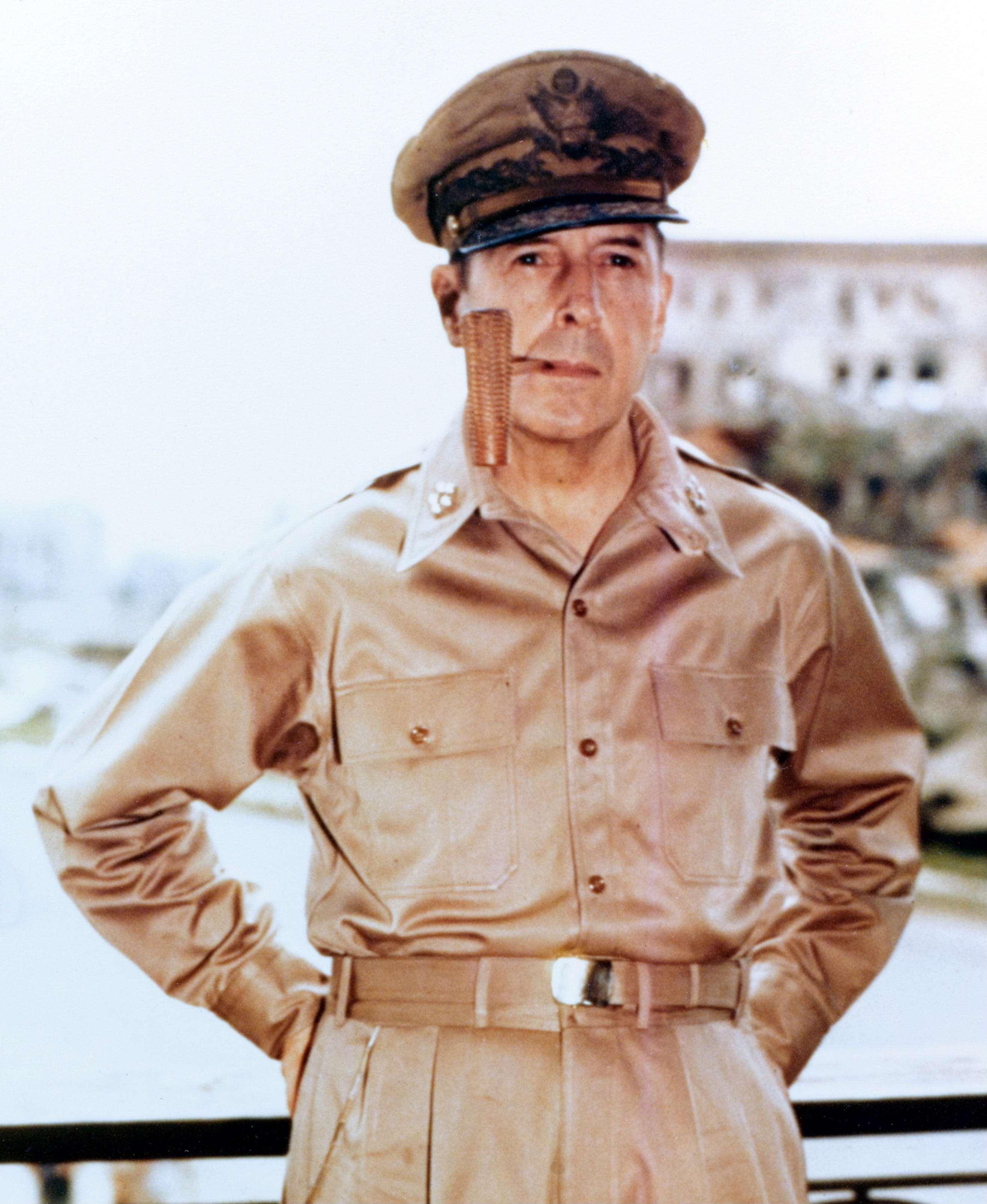
The enormity of General Douglas MacArthur’s military achievement approaches the scale of his legend, though not always the measure of his carefully crafted image. His great biographer William Manchester called him an “American Caesar,” a title that captures both his undeniable command in war and the persona he so deliberately fashioned: the corncob pipe, battered cap with gold braid, bomber jacket, and aviator sunglasses. MacArthur earned the praise such imagery invited, but also the controversy that followed him. Brilliant and often difficult, a servant of the Republic who sometimes seemed to follow a script of his own making, he nevertheless met the nation’s call in its most dangerous hours with resolve and courage, and never shrank from the burden placed upon him.
Douglas MacArthur was born on January 26, 1880, in Little Rock, Arkansas, into a family already steeped in military service. His father, Arthur MacArthur Jr., was a Union Army officer who won the Medal of Honor for his exploits during the Battle of Seminary Ridge and later rose to the rank of general. Douglas’s mother, Mary Pinkney Hardy MacArthur, was fiercely devoted to her son and played no small role in shaping his ambition and self-conception. The young MacArthur grew up on frontier posts, absorbing the discipline of the Army. He was educated at West Texas Military Academy and then entered the United States Military Academy at West Point, where he graduated first in his class in 1903, one of the most distinguished academic performances in the institution’s history.
He was a highly promising young officer, with engineering assignments and service in the Philippines alongside his father. But it was the First World War that forged his public reputation. As chief of staff of the 42nd “Rainbow” Division, and later as a brigade commander, MacArthur consistently displayed conspicuous bravery. He was frequently near the front lines, sometimes to a degree that alarmed his superiors. He was wounded, decorated repeatedly, and emerged from the war as one of the Army’s brightest rising stars. His service record from World War I is staggering: two awards of the Distinguished Service Cross, seven Silver Stars, and the Army Distinguished Service Medal. It was also during this war that the pattern of his career began to take shape. He showed real courage and brilliance paired with theatricality and a willingness to test authority.
In the interwar years, MacArthur’s ascent continued. He served as Superintendent of West Point, where he implemented significant reforms, emphasizing modern training, curriculum, and athletics. He later became Chief of Staff of the Army during the early years of the Great Depression, a period marked by severe budget constraints and institutional uncertainty. It was during this tenure that one of the most controversial episodes of his career occurred. In 1932, MacArthur played a central role in the dispersal of the Bonus Army, a group of World War I veterans protesting in Washington, D.C. for early payment of promised bonuses. Acting under orders from President Herbert Hoover, but arguably exceeding them in scope and severity, MacArthur oversaw the use of troops to clear the encampment. The images of soldiers confronting veterans left a lasting stain on his domestic reputation and raised serious questions about his judgment in civil-military matters.


After his term as Chief of Staff, MacArthur returned to the Philippines, where he served as a military advisor and helped organize the defense forces of the Commonwealth. He developed close ties with Filipino leaders, particularly Manuel Quezon, and envisioned a path toward independence under the protection of a capable native army.
When Japan attacked Pearl Harbor in December 1941, MacArthur was in command of U.S. Army Forces in the Far East. Despite warnings of hostilities, his air forces were caught unprepared and suffered devastating losses on the ground. The Japanese advance was swift and overwhelming. MacArthur’s forces withdrew to the Bataan Peninsula and Corregidor Island, where they conducted a stubborn but ultimately doomed defense. In March 1942, under orders from President Franklin Roosevelt, MacArthur was evacuated to Australia in a daring escape that placed him at considerable personal risk—and for which he was awarded the Medal of Honor. It was in Australia that he delivered the line that would define his wartime persona: “I shall return.”
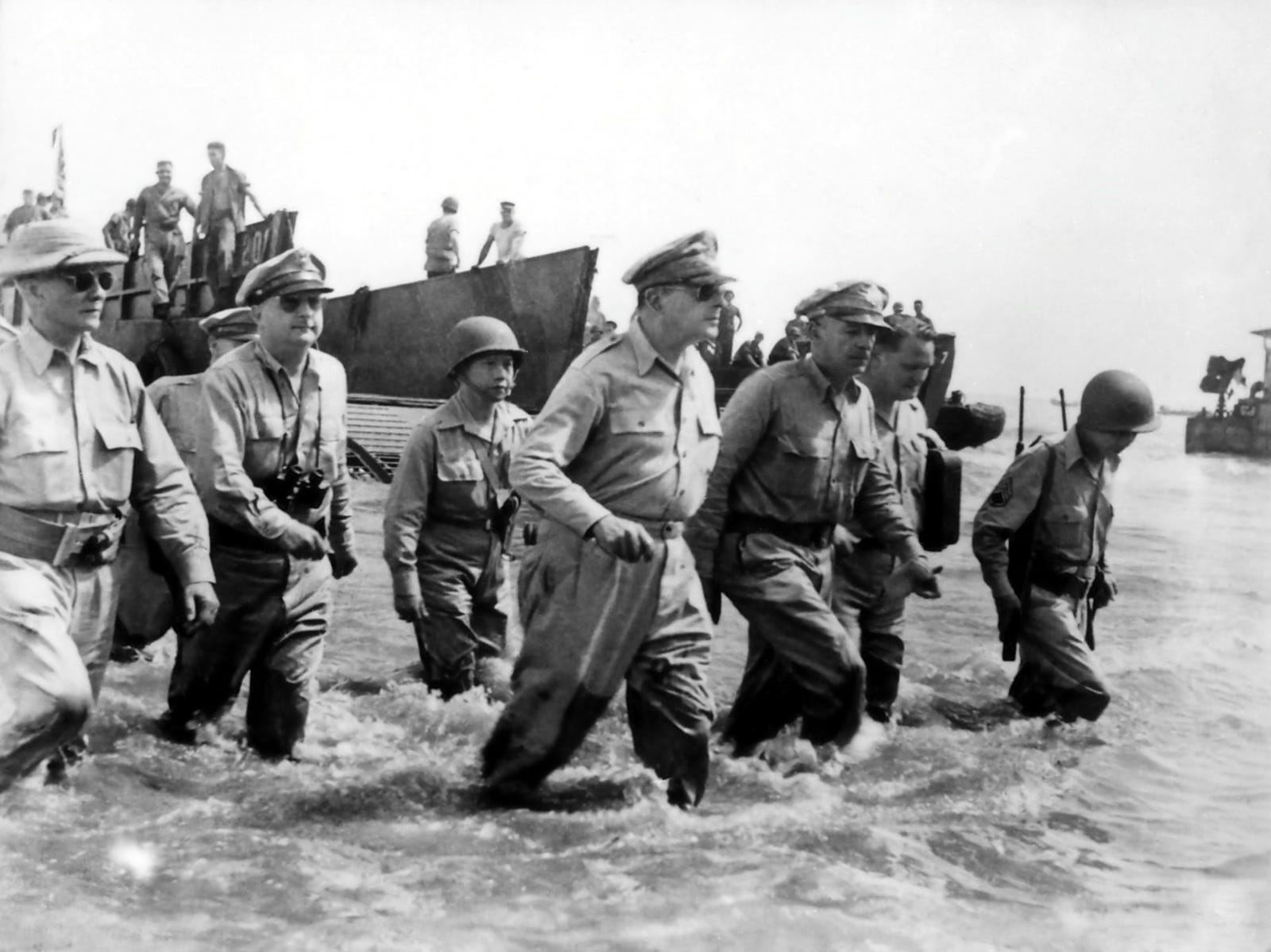
The promise was not merely rhetorical. Over the next two and a half years, as Supreme Commander of Allied forces in the Southwest Pacific, MacArthur directed a campaign that combined strategic patience with bold operational leaps. Rather than assault every Japanese stronghold, he employed a strategy of “island hopping,” bypassing heavily fortified positions and isolating them while advancing toward the Philippines. His forces achieved a series of significant victories in New Guinea and the surrounding islands. In October 1944, true to his word, MacArthur waded ashore at Leyte in the Philippines, a moment carefully staged but nonetheless symbolically powerful. The subsequent campaign to liberate the Philippines was hard fought and costly, culminating in the fall of Manila in 1945. MacArthur kept his promise to return, and the nation’s honor as well. Perhaps the two were the same in his mind.


MacArthur’s conduct in the Pacific War revealed both his strengths and his limitations. He was a superb strategist with a keen sense of the psychological dimensions of warfare. He understood the value of narrative and the power of his visible return. At the same time, his relationships with other Allied commanders were often strained. His rivalry with Admiral Chester Nimitz reflected broader tensions between Army and Navy approaches to the Pacific War, and he also struggled at times in his dealings with other Allied nations. His headquarters was known for its insularity, and his tendency to claim credit did not always endear him to colleagues.
With Japan’s surrender in August 1945, MacArthur entered perhaps the most consequential phase of his career. Appointed Supreme Commander for the Allied Powers, he was effectively the military governor of Japan during its occupation. At this point, the theatrical general became an effective and even humane statesman and administrator. Under his authority, Japan underwent a sweeping transformation. A new constitution was drafted, renouncing war forever and establishing democratic institutions. Land reforms weakened the old landlord class, creating a new middle class and conditions for unprecedented prosperity. Women were granted the right to vote, and labor rights were expanded. The old structures of imperial militarism faded away, except for the person of Emperor Hirohito himself, with whom MacArthur established a surprisingly close relationship.
MacArthur’s role in the occupation was marked by a degree of pragmatism that surprised some observers. Retaining Emperor Hirohito as a symbolic figurehead helped stabilize Japanese society during a fragile transition. He balanced punitive measures with reconstruction, aiming not merely to defeat Japan but to remake it as a peaceful and productive member of the international order. The success of the occupation remains one of the most significant achievements of American foreign policy in the twentieth century, and MacArthur’s leadership was central to it. Japan, once America’s bitterest enemy, is now one of its closest allies.
Yet even in this period of accomplishment, the seeds of future conflict were present. MacArthur had long held expansive views of his own authority and of the proper conduct of war and policy. These tendencies would come to a head during the Korean War.
When North Korean forces invaded South Korea in June 1950, MacArthur was placed in command of United Nations forces. The early months of the war were marked by retreat and near disaster, with UN forces pushed back to the Pusan Perimeter. MacArthur conceived and executed the daring amphibious landing at Inchon in September 1950, a maneuver that turned the tide of the war almost overnight. The North Korean army collapsed under the sudden reversal, and UN forces advanced rapidly northward.


At this moment of triumph, however, MacArthur pressed beyond the limited objective of restoring the status quo ante. He advocated for the reunification of Korea under southern control and dismissed warnings about potential Chinese intervention. When Chinese forces entered the war in late 1950, the conflict shifted dramatically. UN forces were forced into a difficult retreat, and the war settled into a protracted and costly stalemate.
During this period, MacArthur’s longstanding tension with civilian authority became untenable. While serving in uniform, he publicly criticized the policies of President Harry Truman and his strategy of limited war. He challenged and at times circumvented official policy, placing strain on the principle of civilian control of the military. In April 1951, Truman relieved MacArthur of his command.
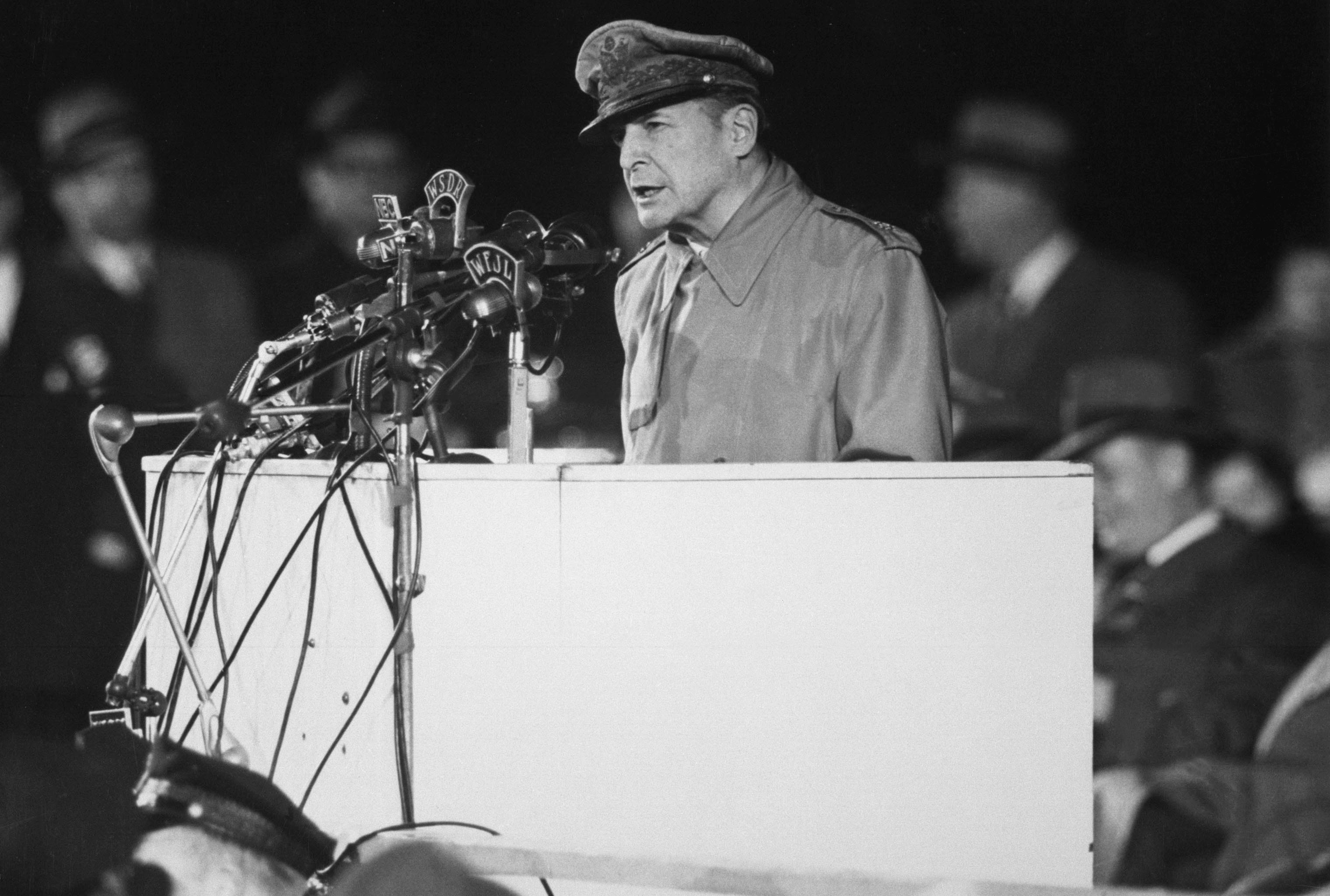
The dismissal was one of the most dramatic civil-military confrontations in American history. MacArthur returned to the United States to a hero’s welcome and addressed a joint session of Congress, delivering his famous line: “Old soldiers never die; they just fade away.” Truman’s decision to remove MacArthur was ultimately a sound one. MacArthur’s brilliance in command could not excuse a breach in the fundamental principle that the military serves under civilian direction.
In his final years, MacArthur remained a public figure, though he never again held command. He wrote his memoirs and occasionally offered counsel on military affairs. He died on April 5, 1964, closing a life that had touched nearly every major conflict of the first half of the twentieth century.
Douglas MacArthur was a man of immense gifts: courage, intellect, and an almost uncanny sense of the symbolic power of leadership. He inspired loyalty in his troops and achieved victories of lasting consequence. The reconstruction of Japan stands as a testament not only to American power but to a vision of what that power could accomplish when guided toward renewal rather than destruction. His command in the Pacific was peerless. His flaws notwithstanding, he stands out among the many great soldiers who defended the Republic.
with gratitude, and love—