

America's Writer
41. Mark Twain

41. Mark Twain (1835–1910)
Before America produced world-famous novelists, it produced pamphleteers, preachers, diarists, and statesmen. The American mind, especially in the colonial and revolutionary eras, was practical, political, and often pious, but not especially literary or artistic. After independence, American literature spent decades reaching for respectability, often by imitating European forms. American writers borrowed English diction and sensibilities, as though cultural legitimacy still required London’s approval. But America was not England. It was rougher, younger, and in many ways much more absurd. Its literature would never, could never, be the same. Eventually, it required a writer who could capture America’s voice with artistic integrity and without apology. Mark Twain did both.
He was born Samuel Langhorne Clemens in 1835 in Florida, Missouri. Twain entered the world in a nation still young enough to remember the Revolution but already boisterously surging westward. Shortly after his birth, the family moved to Hannibal, Missouri, a Mississippi River town that forever shaped his imagination. Hannibal was a place of commerce, folklore, superstition, slavery, and adventure. Boys roamed freely, riverboats arrived bearing strangers and stories, and the frontier was near. It was exactly the kind of place where the myth of America lived, and could be made.
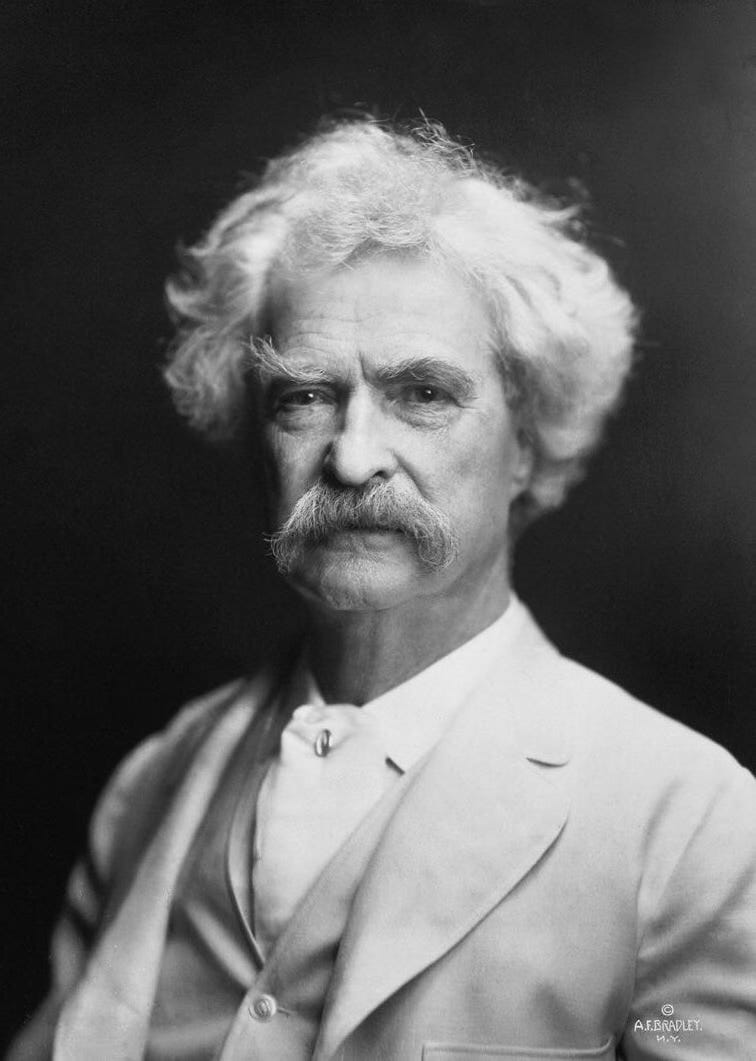
Twain’s father, John Clemens, was stern and ambitious, but often financially unsuccessful. His death when Samuel was eleven forced the boy to work at a young age. Twain became a printer’s apprentice and later worked as a typesetter, learning language not in lecture halls but in newspaper shops, among practical men who valued clarity, speed, and sharp wit. Twain was not an academic stylist. His prose was not elevated drawing-room language, but the language of everyday Americans: tradesmen, hucksters, journalists, gamblers, and tellers of tall tales.
Most importantly, as a young man, Twain found the Mississippi River. He trained as a steamboat pilot, one of the most prestigious and technically demanding professions in antebellum America. Piloting the Mississippi required memory, nerve, intimate local knowledge, and instinct. It was dangerous work. It also gave him the pseudonym that would make him immortal. “Mark twain” was a riverboat call indicating the safe depth of two fathoms of water.
But the Civil War shattered that world. River commerce collapsed, and with it his safe and prestigious career. Twain briefly joined a Confederate militia unit, though only for a short and unserious stint, before heading west with his brother to the Nevada Territory. There, he prospected for gold and silver, failed as a miner, drifted into journalism, and began developing the comic voice that first brought him fame.
His breakthrough came in 1865 with The Celebrated Jumping Frog of Calaveras County, a comic short story that established Twain as a national humorist. America loved it because it sounded characteristically and hilariously American. It was informal, exaggerated, sly, and utterly unconcerned with European literary propriety. But Twain was obviously more than a humorist. He was sharply observant, skeptical, and at times morally outraged.


His travel writings, including The Innocents Abroad (1869), became enormously successful. Americans saw themselves in Twain’s irreverent narrators, who punctured pretension and treated Europe’s cultural grandeur with democratic suspicion and bafflement. Twain mocked fake sophistication and incomprehensible ceremoniousness. He understood that Americans were becoming wealthy enough to tour Europe, but still culturally insecure enough to seek its approval. He found such a combination absurd and offered liberation through laughter.
His marriage to Olivia Langdon in 1870 brought stability and social elevation. Olivia came from a cultivated, wealthy family, and her influence helped temper Twain’s rougher public persona. The marriage was affectionate, though often strained by financial and personal hardship.
The great works followed. The Adventures of Tom Sawyer (1876) distilled boyhood freedom and recast it into national myth. Youthful endeavors such as whitewashing fences, treasure hunts, and cave exploration became something larger than children’s fiction. Twain transformed ordinary American childhood into deeply meaningful literature.
But it was Adventures of Huckleberry Finn (1884) that secured his place in immortality. Few novels better capture the contradictions of America itself. The book is funny, restless, inventive, and linguistically revolutionary. Twain allowed characters to speak in authentic vernacular rather than polished literary English. This alone changed American writing. Ernest Hemingway famously claimed that all modern American literature came from Huckleberry Finn.
The novel is also morally serious. Huck, an uneducated boy shaped by the prejudices of his society, gradually comes to recognize Jim’s humanity despite everything he had been taught. The emotional climax is when Huck resolves to help Jim even if it means eternal damnation, declaring, “All right, then, I’ll go to hell.” That sentence remains one of the great moral moments in American fiction because Huck does not believe he is doing something heroic. He believes he is doing something wrong, but chooses friendship anyway.


Twain’s relationship with race, however, was more complicated than simple retrospective sainthood permits. He was a white southerner shaped by a slave society. Yet over time, his views evolved significantly. He condemned slavery, supported Black education, and became one of the more morally serious American writers confronting the nation’s hypocrisy over race. Still, like many figures of his era, he carried assumptions modern readers rightly scrutinize.
Twain’s satire expanded beyond fiction. In works like The Gilded Age (written with Charles Dudley Warner), he lampooned greed, corruption, and corporate excess so effectively that the title became the enduring label for the era itself. Later writings attacked imperialism, hypocrisy, and political pretense with increasing bitterness.
Twain was not always financially prudent. He made disastrous investments, including in a failed typesetting machine, and suffered near ruin. To repay his debts, he embarked on exhausting international lecture tours. He refused to escape his obligations through bankruptcy, and those tours substantially increased his public profile.
Personal sorrow deepened his later years. He lost children. He lost his beloved Olivia. His humor darkened. The older Twain became increasingly pessimistic about human nature. The playful humorist of earlier years gave way, in part, to a more cynical observer who doubted progress and distrusted mankind. Some late writings are almost volcanic in their contempt for human folly.
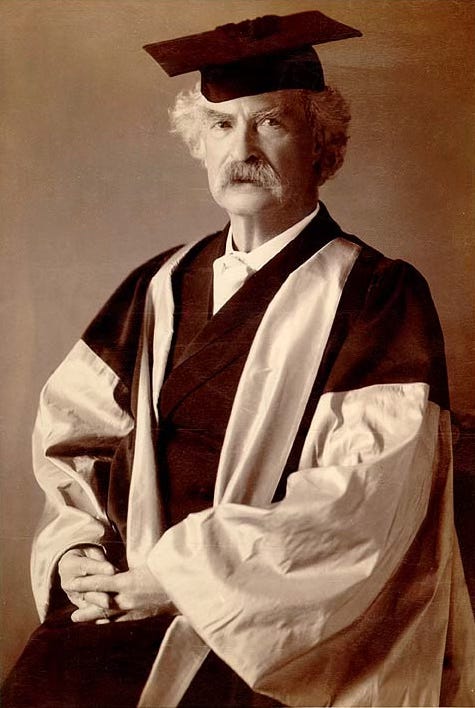
Twain died in 1910, just as the America of horses, riverboats, and the frontier gave way to automobiles, mass industrial society, and global power. He had been born the year Halley’s Comet appeared and famously predicted he would depart with its return. In fact, he did.
Few Americans have so thoroughly shaped national self-understanding. Twain gave American letters permission to sound like themselves. He found grandeur in vernacular speech, moral meaning in ordinary lives, and comedy in democratic chaos. He exposed frauds, mocked pretension, and captured both the innocence and cruelty of American life.
Many great American writers followed. Few cast a longer shadow.
with gratitude, and love—