

American Moses
50. Brigham Young

50. Brigham Young (1801-1877)
The history of the American West is shrouded in myth, in part because its settlement unfolded at genuinely mythic scale. Americans crossed, claimed, defended, contested, prayed over, and built across the prairies, mountains, deserts, and basins of the continent. Arguably, no single person did more to shape the course of that western settlement than Brigham Young. He was neither explorer nor fortune-seeking adventurer. He was, to his followers, a Moses leading a persecuted people toward refuge beyond the reach of the United States. Yet in seeking sanctuary, he presided over one of the most successful colonizing enterprises in American history. Under his leadership, Mormon settlers founded more than 250 communities across the West, planted farms, cut roads, dug canals, established schools, and raised temples. Together, they built a durable society in one of the continent’s harshest and most forbidding landscapes. Young’s legacy is immense, difficult, and foundational to the making of the American West.
Brigham Young was born in 1801 in Whitingham, Vermont, into the rough world of the early American frontier. His father, John Young, was a farmer and veteran of the Revolution, and the family lived the hard, mobile life familiar to many Americans pushing outward in the young republic. Formal education was sparse. Young later remarked that he had received only a handful of days of schooling. He was formed more by work than books, and his work was varied. He was a carpenter, painter, glazier, and craftsman. He was neither polished nor inclined toward gentility. But he was disciplined, confident, and forceful.
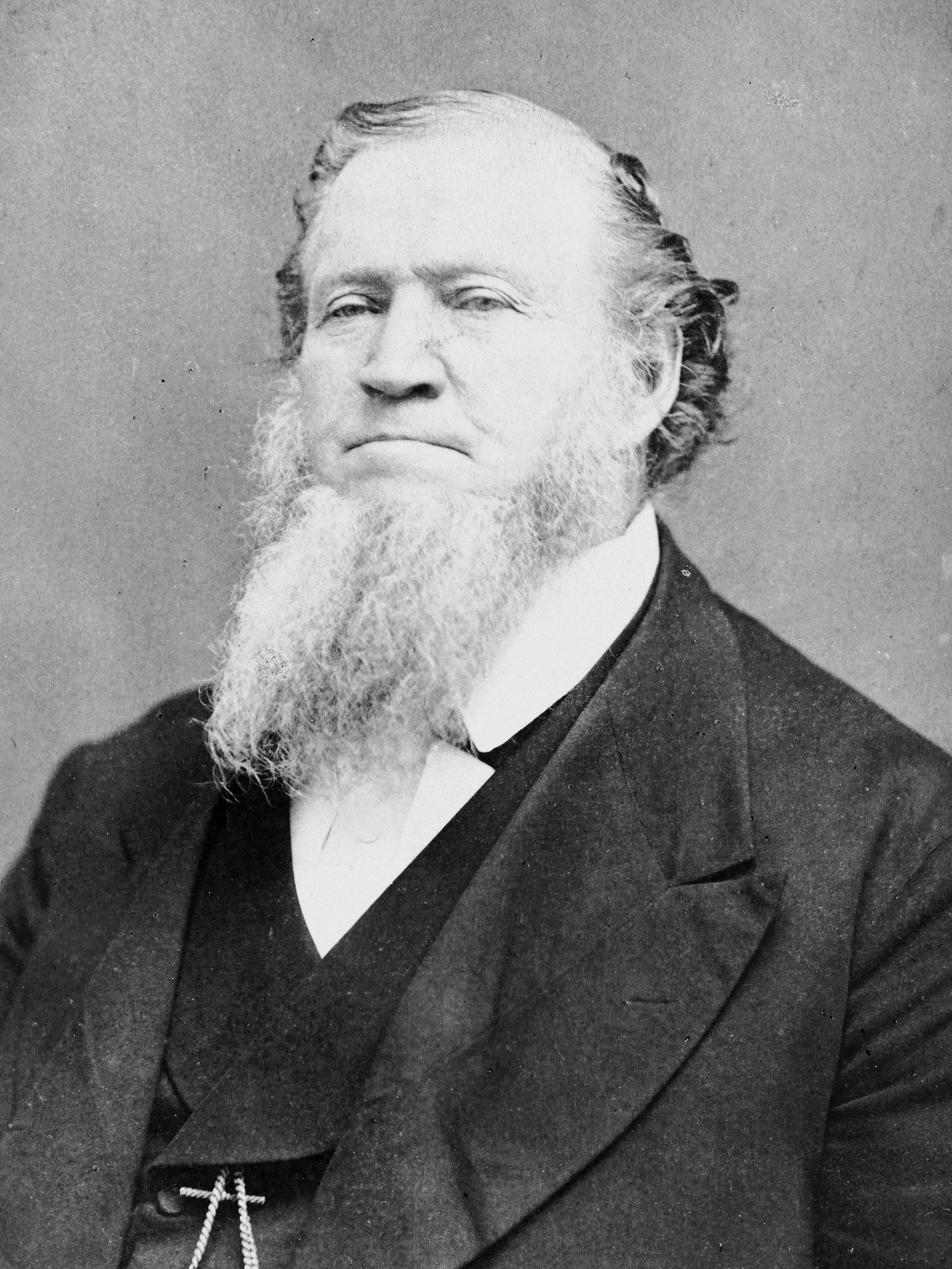
The world of Brigham Young’s youth was in religious upheaval. The Second Great Awakening stirred the countryside, especially upstate New York, with revivalism, experimentation, and intense spiritual searching. Young partook of that atmosphere, though he did not immediately join the many enthusiastic sects around him. In 1830, when the Book of Mormon appeared through Joseph Smith, Young was initially skeptical. But after investigation and conversations with his brother Samuel, he converted in 1832. That decision altered both the course of his life and, eventually, the history of the American West.
Young quickly became one of Joseph Smith’s most capable lieutenants. Where Smith was charismatic, visionary, and improvisational, Young was organizational, methodical, and relentless. The early Latter-day Saint movement needed both men. Mormonism in the 1830s and 1840s was not merely a church but a rapidly growing religious community under intense pressure from outside hostility and internal instability. Young proved indispensable. He joined the Quorum of the Twelve Apostles in 1835 and took on increasingly significant leadership responsibilities during crises in Missouri and Illinois.
The Saints endured real and severe persecution. Conflict with neighbors in Missouri culminated in expulsion under the infamous extermination order of Governor Lilburn Boggs. In Illinois, the city of Nauvoo rose rapidly into one of the largest communities in the state, but tensions followed there as well. Political bloc voting, suspicion about Mormon theology and political power, economic rivalry, and Smith’s increasingly expansive authority deepened hostility and fear. Most explosively, the introduction of plural marriage, or polygamy, intensified controversy further, though it remained largely secret during Smith’s lifetime.


In 1844, Joseph Smith was murdered by a mob at Carthage Jail. The crisis that followed might have destroyed the movement. Charismatic religious movements often fracture after the death of a founder. Mormonism survived in substantial part because Brigham Young seized the institutional center and held it. In a dramatic succession struggle, Young persuaded the majority of the Saints that leadership properly belonged with the Twelve Apostles rather than rival claimants. It was one of the decisive moments in Mormon history. If Smith founded Mormonism, Young made it durable.
By 1846, the Saints faced mounting pressure to leave Nauvoo. Young organized one of the great forced migrations in American history. Thousands moved west across Iowa under miserable conditions, eventually establishing Winter Quarters in present-day Nebraska. In 1847, Young led the vanguard company into the Salt Lake Valley. Tradition records his declaration that this was “the right place.” The valley was remote, arid, isolated, and unattractive to most Americans. That was precisely the point. It was refuge for the Saints, far from Missouri, Illinois, and the mobs.
Young wasted little time after arriving. Settling the Great Basin was one of the most ambitious colonizing enterprises in nineteenth-century America. Mormon settlement was not haphazard frontier improvisation. It was organized expansion. Young sent families to establish communities across what became Utah, Idaho, Arizona, Nevada, Wyoming, and beyond. Settlements were carefully planned. Water rights were allocated, irrigation systems constructed, and land apportioned. Young saw to it that communities were designed with social cohesion and religious purpose in mind. The desert bloomed, but not by accident. It bloomed through engineering, discipline, and extraordinary communal labor.
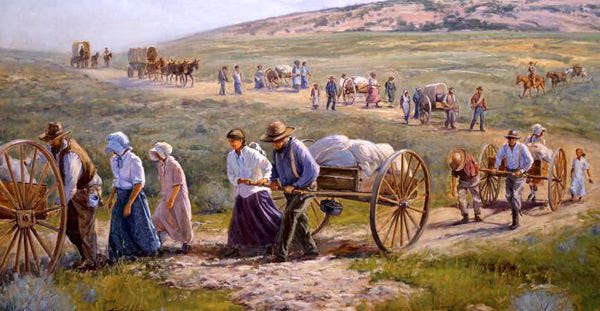
Young’s practical genius was most visible here. He understood logistics, labor, agriculture, and leadership. He preached self-sufficiency, economic cooperation, and local industry. The Mormon commonwealth he envisioned was not merely a church community but an alternative civilization in the West, semi-independent in spirit even as American sovereignty expanded around it. The word he used for that vision was Deseret, a term from Mormon scripture meaning “honeybee,” a symbol of communal industry.
But Deseret’s expansion brought conflict. Following the Mexican-American War, the territory Young had entered became part of the United States. Young sought recognition for a massive proposed State of Deseret, but Washington instead created Utah Territory in 1850, naming Young its first territorial governor. For a time, he simultaneously served as governor, superintendent of Indian affairs, and church president, an extraordinary concentration of authority.
This arrangement was never likely to remain stable. Federal officials increasingly viewed Mormon Utah with suspicion, especially over plural marriage, theocratic governance, and perceived disloyalty to national authority. Those tensions culminated in the Utah War of 1857–58, when President Buchanan sent federal troops after receiving alarming reports of rebellion. Full-scale war was narrowly avoided, but the episode cemented mutual distrust.
Young’s relationship with Native Americans was complicated and inconsistent. At times he pursued far-sighted diplomacy, trade, and coexistence. At other times conflict turned violent. His oft-quoted preference to “feed rather than fight” reflected one policy instinct, but Mormon expansion inevitably displaced indigenous peoples, altered land use, and generated repeated confrontation with the Utes, Shoshones, Paiutes, and Goshutes. Like nearly every American colonizing project of the era, settlement came at profound native cost.
No honest account of Young can avoid darker chapters. The most notorious remains the Mountain Meadows Massacre of 1857. A wagon train passing through southern Utah was attacked by Mormon militia and allied Paiute participants, resulting in the slaughter of roughly 120 emigrants after a false promise of safe conduct. Young did not order the massacre, and historians generally agree he was unaware of the attack before it occurred. But the broader climate of siege, militant rhetoric, and distrust toward outsiders formed part of the environment in which it happened. He was certainly responsible for helping create that climate, and his legacy cannot be separated from the event.
Nor was race absent from that legacy. Under Young, the church adopted restrictions barring Black members from priesthood ordination and temple participation, marking a significant and deeply troubling departure in Mormon practice. In this, his legacy failed to transcend the prejudices of his age.
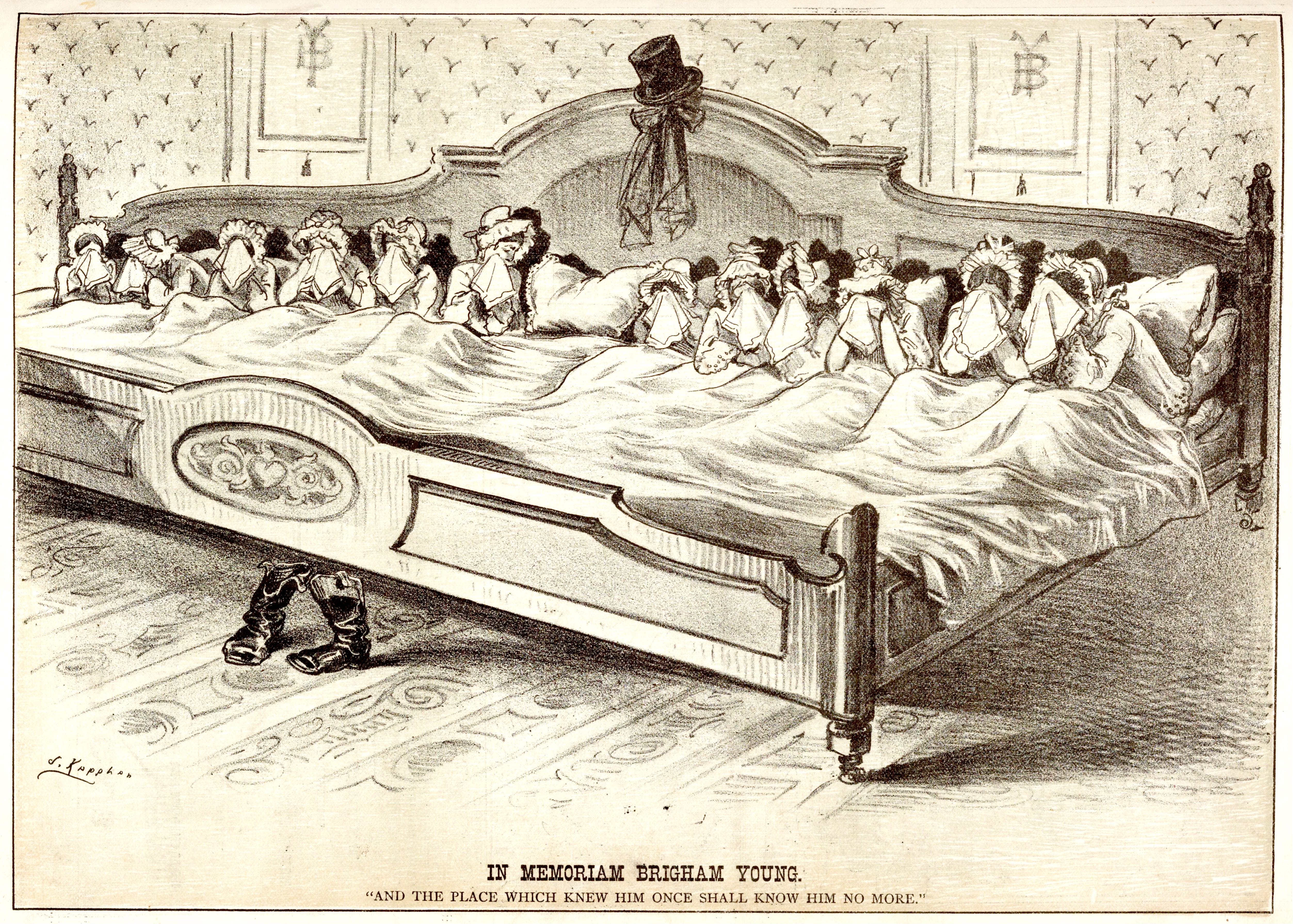
Nor can his legacy be separated from plural marriage. Young openly practiced polygamy after its public acknowledgment, taking more than fifty wives and fathering a very large family. To modern sensibilities, and indeed to many contemporaries, the practice was troubling at best and intolerable at worst. Many faithful Saints struggled with it as well. But to Young and other believers, including many plural wives, it was central to the religious structure of the nineteenth-century church he led. Whatever one’s view of the theology, its institutional significance is beyond dispute.
Young was personally a formidable man. He could be blunt, earthy, humorous, authoritarian, pragmatic, and fiercely loyal. He inspired both deep devotion and deep hostility. Admirers saw a modern Moses. Critics saw a despot in frontier robes. Both impressions captured something real.
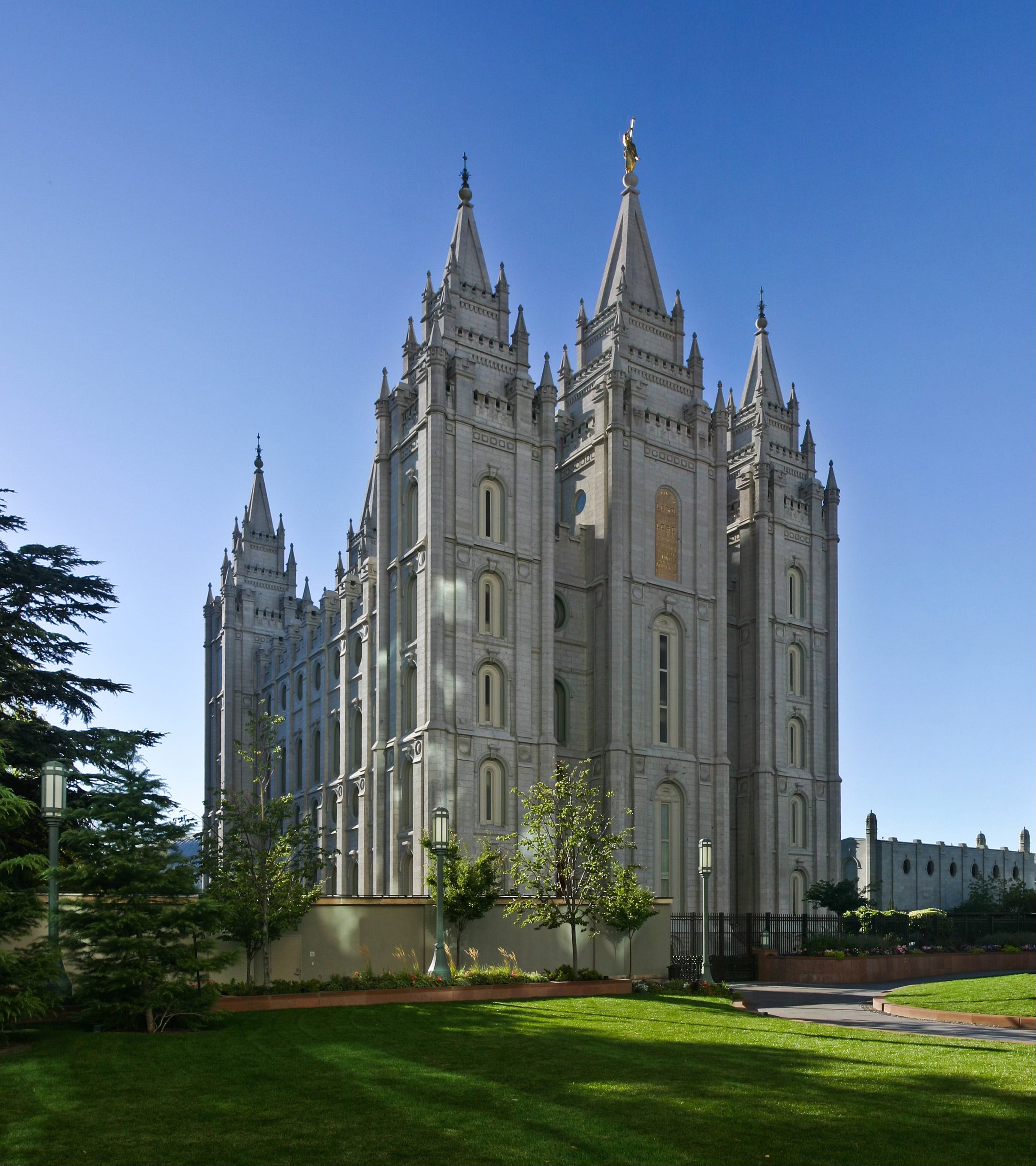
But Young also built institutions that endured. The State of Utah is nearly inconceivable without him. The University of Deseret, later the University of Utah, emerged during his era. Brigham Young University would later bear his name. The Salt Lake Temple, though completed after his death, was his vision. The physical and cultural architecture of the Intermountain West still bears his fingerprints. Mormon pioneers founded communities whose influence extended far beyond Utah itself, with settlements and supply networks affecting the development of places as distant as Nevada, southern California, and Arizona.
By the time of his death in 1877, Brigham Young had done something extraordinary. He had taken a persecuted religious minority repeatedly driven from settled communities in the East and transplanted it into one of the harshest environments in North America, where it built a durable and thriving civilization. Few Americans have so visibly shaped a region.
with gratitude, and love—